July 28, 2009
francais
1 Comment
A French cartoonist has explained the effect of the proposed Hadopi 2 law in France:
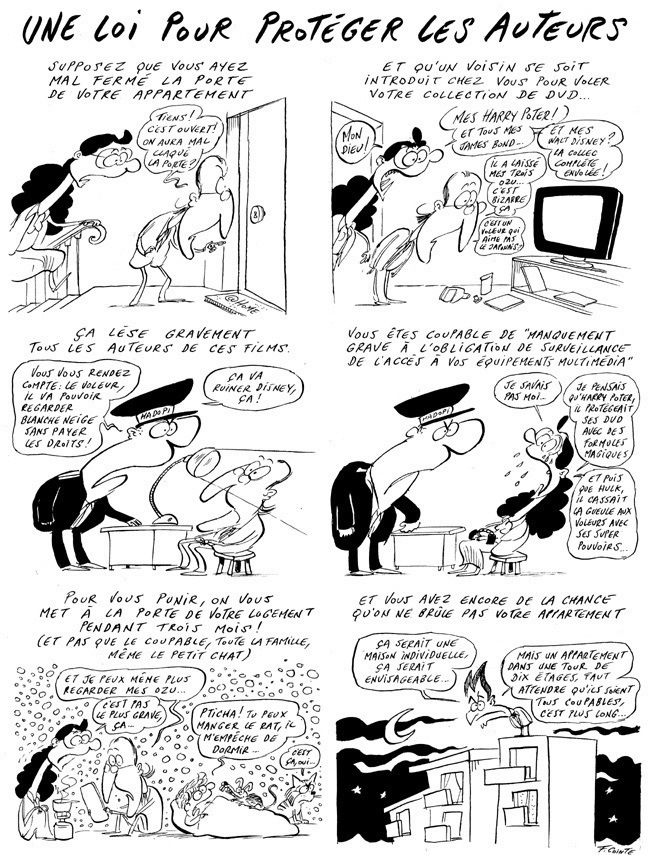
The dummies guide to Hadopi
Translation:
A law to protect authors
- Suppose you didn’t close the door to your apartment properly.
- Hey! It’s open! We didn’t pull it shut properly?
- And a neighbour came in and stole your DVD collection
- My God! My Harry Potter collection! And all of my Disney collection! Gone!
- He left my three Ozu films… that’s weird. A thief who doesn’t like the Japanese?
- This seriously hurts all the authors of these films
- Do you realise, the thief will be able to watch Snow White without paying! This will ruin Disney!
- You are guilty of “a serious breach of the obligation to monitor access to your multimedia equipment”
- I didn’t know! I thought that Harry Potter protected his DVDs with a magic spell. And that the Hulk beat up thieves with his super powers.
- As punishment, you are thrown out of your apartment for 3 months! (And not just the guilty party, the whole family, even the pet cat)
- I can’t even watch my Ozu any more
- That’s not the worst of it
- lil’cat! Eat this rat, he’s keeping me from sleeping!
- Yeah, right…
- And you’re lucky that we don’t set fire to your apartment
- If it was a house, I’d think about it. But in a 10 story apartment block, we have to wait until everyone is guilty! It takes a little longer.
For some background for non-French people: Hadopi is a law which says that if anyone downloads copyrighted material illegally over your internet connection, your internet access can be cut off for up to 3 months. I believe that you get 2 warnings before it gets cut off, but that the decision is made by an “independent” commission, and not by a judge, so you don’t have any recourse to appeal. The first version of the law was struck down by the French constitutional court, and the law is back with a second wind now.
The goal of protecting copyright holders is not a bad thing. I even mostly approve of the goal – it’s the rule of law by which free software lives and dies. But this is a bad law, badly drafted, and like “security” in airports will have far wider ranging collateral damage than the government realises.
July 22, 2009
community, freesoftware
13 Comments

Barriers to entry
I often talk to vendors who are interested in growing their developer communities around their free software projects. When I do, my advice centers around two things, one of which I think I can help with.
The first is your project vision – why would someone look at your stuff instead of anyone else’s? You are competing for the attention of the pool of free software developers out there, as well as trying to grow that pool, and what will draw people to your project is your vision.
The second is the Hippocratic principle of community building: Primum non nocere, first do no harm.
Most communities fail to reach critical mass because someone becomes interested in your project, and just bounces off it, because of some difficulties they meet when engaging you. To build a successful community, it is usually sufficient to build a compelling vision, and remove all non-essential barriers to participation in your project that exist.
I have compiled a check-list of various barriers to entry which are found in vendor-led projects, roughly grouped into technical, social and legal barriers to entry. Sometimes it’s appropriate for a new community member to face a learning curve – you want to maintain a tone in your community, and ensure that core developers understand the social and technical norms of your project – but often the things that they have to learn are incidental, rather than essential, and removing these is a worthwhile thing to do.
Without further ado, here is Community barriers to entry (pdf) – I’m publishing this under CC BY-SA 3.0 and I would be delighted to get feedback on this to help improve it and make it more useful. Comments welcome!
July 16, 2009
gnome, guadec
No Comments
Saturday morning, dragged my sorry ass out of bed to get to the conference hall for 9am. Shared a taxi with Stormy & Behdad, got my badge, met the keynotes (except Richard, who I was told would be arriving later), briefed them on how the morning was going to go down. I had some hastily written introductions for each of the keynotes I wrote around 2.30 the night before, after Stormy told me that it looked like I was going to be introducing people.
The opening got underway at 10:00, and kept good time. The local politicians who wanted to show their support and excitement without getting in the way did a fine job. Thank you very much to the Cabildo, the high school and the university for having us.
I introduced and attended all the keynote sessions, I was particularly impressed with Robert Lefkowitz‘s (better known as r0ml) presentation, although I would have liked to hear the end of his argument (I got a chance to get the main details later, and I like it). As I said in his introduction, Robert never tires of teaching us that the ideas which we consider radical and revolutionary now were also radical and revolutionary centuries ago. In this case, Robert was arguing that software development was more liberal art than production, and thus as a liberal art, it is something which people should learn merely for the enjoyment of the pursuit. In his words, liberal software is software which a gentleman would use. The continuation of the argument is thus that liberal software is more like reading and writing than brain surgery, and thus in time, everyone should learn the basics of programming, since it will be just another way of expressing oneself. He also mentioned an aside that since liberal, unlike “free” or “open” is a gradient rather than an absolute, it is possible for software to be more or less liberal than other software, with some unusual conclusions.
The second keynote, Walter Bender, former president of One Laptop per Child, and current executive director of Sugar Labs, presented his vision for educational software, which was the really revolutionary part of the OLPC project, and his continued pursuit of that vision through Sugar Labs. A cause worthy of our support.
Half way through Walter’s presentation, I was getting a little worried that I had not yet seen Richard. So I got up, and asked around, I was informed that he was here, in the building somewhere, and would be in the auditorium 5 minutes before it was time for him to start. The problem is that I didn’t know where he was, and hadn’t yet met him.
Later in the presentation,Walter was coming to the end of his planned slides rather earlier than had been planned, so I asked a local organiser to find Richard and get him to the auditorium ASAP. In the end, Walter demonstrated some of the Squeak tools on the Sugar system, and even ran a little over time. Not knowing what to do, I thanked him for his presentation, and told the masses that Richard was around somewhere, and that we would get him ASAP. Unfortunately, a significant number of people took this to mean that there was a break, and started leaving the auditorium, around the same time that Richard entered, from stage right, apparently unaware that I had been frantically trying to get him to the hall.
Anyway, after introductions, Richard Stallman started his presentation, with people still coming back into the hall. After an overview of the four tenets of free software, he gave a history lesson of the origins of GNOME, and a warning about the dangers of Mono, before his Saint Ignucius segment which has garnered so much attention, and the auctioning of a gnu (benefits to the Free Software Foundation) for €150 if memory serves, and some rather heated Q&A.
After that, Richard went for a press conference, and I went to lunch with our other invited guests to a very nice tapas place near the beach.
In the afternoon, Quim Gil of Nokia presented the future of the Maemo project, a future closely coupled to GNOME technology, but whose face will be QT from Maemo 6 onwards.
I was in the press room for some press conferences and interviews for the rest of the afternoon, but before leaving I had a funny story at the start of the lightning talks where my laptop, which Quim had borrowed for his presentation, and which I left there for the lightning talks, didn’t appear to be working any more, and in spite of frantic xrandr manipulations, we could not get the screensaver off the big screen.
The organisers finally realised what was going on, and turned off the screensaver, which was in the projector. This is particularly funny because, after the first lightning talk finished, the technician once again put the screensaver up, and the person running the lightning talks (sorry Mr. “Buried in the Sand” Mexican, I can’t remember your name) wasn’t aware of what had gone before, causing him to think my laptop was broken. More xrandr/frantic hand-waving/laptop changing followed, before the technician once again removed the screensaver. I believe we got to the 3rd presentation before he realised that we didn’t want the screensaver between 5 minute presentations. It’s moments like those that make you realise the importance of talking to the A/V technicians beforehand so that hand signals and instructions are known to all concerned.
One person remarked that this kind of story is typical of free software hackers – while other people arriving to give presentations go talk to the organisers and say “here, I am in your hands, instruct me”, we want to use our own laptops, record our own video, and in general master and change our environment.
Anyway, after the conference, I headed out to dinner with Karen Sandler, Walter, r0ml and some other people we met on the way to look for a very nice place I had eaten in with Vincent, Claudia, Will and Sebas when scouting the place in December. Unfortunately, my well placed intentions were not matched by a sense of direction and good memory, but we ended up in a very nice grill place where we had also eaten in December. Nice wine & food was had, interspersed with funny and tragic stories (sometimes both at the same time), capped off by some very nice rum, offered by the establishment.
Beers near the beach, followed by some later beers with Matt Garrett and others (what happens in Gran Canaria stays in Gran Canaria) crowned off a choc-a-block day that ended around 2am.
July 16, 2009
community, guadec, maemo
7 Comments
Note: I actually wrote something like this already in GNOME Blog, and a combination of the Intel graphics freezes in Jaunty and GNOME Blog not creating a local copy of in-progress entries cost me the lot. Funny that WordPress, a web-app, offers better transparent data retention across unexpected events than a local client. I have resolved to use Tomboy for drafting blog entries off-line now, and to figure out how to patch GNOME Blog to save drafts.
My Gran Canaria adventure started in a funny ha ha way when I got the airport and I was told I wasn’t on the plane which I had a ticket for. I checked my email to ensure I hadn’t received any schedule change emails, and found the last mail I received from Expedia, indicating I was booked on the 15h flight from Lyon to Madrid. But the friendly & helpful people at the Air France desk eventually figured it out, the airline had bumped me to an 8am flight, with a transfer to Gran Canaria arriving in the early afternoon. The travel agent wasn’t aware of it (I checked later when I got some internet access). So the Air France people asked if I minded flying through Bilbao, I said no (imagining they meant that I’d be flying from Lyon to Bilbao), and they checked in my bags, and gave me a boarding pass. For the plane to Madrid.
“I don’t understand”, I said. “We can’t issue you a boarding pass for the Madrid-Bilbao or Bilbao-Las Palmas legs now”, they explained. Ah. When I looked at the transfer times, and realised that (if we were on time) I would have 30 minutes to transfer in Bilbao, I was told that I would probably be able to get a boarding pass for the Bilbao-Las Palmas in Madrid.
When I got to Madrid, I queued behind some Swedes who were on their way to some holiday destination and had just been told that their flights were over-booked, and that they’d be staying in Madrid for the night. Happy happy joy joy. I also surprisingly ran into Alex Larsson, who was looking for a boarding card for his flight to Gran Canaria, which was delayed. I debated asking to get on the flight with him for a second, but figured that my bags wouldn’t make it even if I did, so I decided to play it safe.
The transfer desk in Madrid couldn’t issue me a boarding card for Las Palmas, so with 35 minutes transfer time, I would have to find the transfer desk, get a boarding pass, and hope that both my bags and I made it to the plane on time. I was not optimistic. After checking in, I bought a nice bottle for the SMASHED meeting, a Yamazaki 10yo.
Landed in Bilbao (the approach looks beautiful, I really want to visit the Basque country now), and found that there was no transfer desk. I had to go past security, with my newly purchased bottle of Yamazaki, check in, go back through security, and have my bags and I both make the plane. I have learned over time that the quality of hustle is important in airports. Relax when things are beyond your control, and when you can do something about it, run. So I ran. Headless chicken style.
An airport attendant who took pity on my cause very kindly brought me out through the security check-point, and I left my whiskey with the security guard. Ran to the first check-in counter I found to ask where I could check in for my flight. And by complete coincidence, the girl who was supposed to be manning the check-in desk had stepped away, since the flight was almost closed, to chat with her friend, who was minding the check-in desk I ran to.
Checked in, registered baggage tags to get the bags on the plane, back through security, got my whiskey back, ran to the plane, and (with take-of delayed a few minutes) felt much more confident about making it to the islands that night, with baggage in tow. Be thankful for the kindness of strangers. And it’s better to be born lucky than rich. All in all, a day made much better by the desire of everyone I met to be nice & helpful, in spite of the bureaucracy they work under.
Landed, picked up my bags, got a taxi to the hotel, and dropped them off. Said hello to someone with a laptop in the lobby (Hi mpt!), and ran to the welcome party to see if anyone was left, as it was now almost midnight local time.
I forgot this was Spain.
I met lots of people on the way. Lots of people (but no free beer) were still at the party. Talked briefly with Stormy, Lefty and family, Quim, Oskari, Henri, Sebas, Richard Dale, Rob Taylor and many more over a couple of nice beers. Thanks Canonical for the t-shirt and for the party, a great time was had. Home & to bed by 3. So endeth day 0.
July 15, 2009
community, gnome, guadec
13 Comments
First in a long series that will probably get finished next June, just in time for the next edition
Of course I was aware of the reaction to RMS’s keynote during the conference, and spoke about it with Lefty on a number of occasions.
I have been bothered by the creation of a “meme” which has, apparently, been perpetuated by people who weren’t even at the conference. The meme seems to be speaking more to Richard’s Mono comments (my opinion here) rather than the Emacs virgins segment, but it’s sufficiently ambiguous that I can’t tell.
If people are primarily concerned about the Mono comments, then say so – it’s not useful to conflate two issues. If you’re primarily concerned with the emacs virgin jokes, then for all those who weren’t at the keynote, or who don’t remember exactly what Richard said, go look at it now:
Aside: anyone know how to embed a youtube video on GNOME Blogs?
Richard is sufficiently predictable that he has been giving the same segment, word for word, for many years – last week was my third time to hear it – and to my knowledge this is the first time there has been such outcry.
Personally, I didn’t think it was offensive. As a born & bred (unbelieving) catholic, we’re big into the Virgin Mary ourselves, and while the “relieving them of their emacs virginity” line felt a bit awkward, I didn’t think that the segment was particularly offensive or inappropriate. I could see how others might feel uncomfortable, and so I have no problem with someone who did feel that way taking the point up with Richard directly. Go look at the video, and make up your own mind.
This is to underline a point: Offensiveness is in the eye of the beholder. It is dangerous to jump on a band-wagon about something as significant as whether someone was inappropriate or not if you were not there. I spoke to a number of people who were bothered by the speech, and many more who hadn’t noticed anything in particular, and who laughed along. It’s very easy to jump on a morally outraged bandwagon, without knowing what we’re talking about exactly.
I don’t mind people being morally outraged, I occasionally am myself, but at least make sure you are before you get in a huff. I have a lot more respect for Lefty, Chani and others who were at the conference than the sheep jumping on the issue as an easy way to take a pot-shot at the FSF and Richard Stallman. Oh – and for all the Boycott Novell crowd that are jumping on this as a way to get at people who support Mono, the same thing I said earlier goes for you too – conflating the issues isn’t helpful, in fact it’s inflammatory, stop harming our community with your bad behaviour.
By the way, the “Stop sexism” sign referred to a presentation in a rails conference, where a guy was using scantily clad glamour model shots to illustrate his talk about how “hot” rails was, IIRC. A bunch of rails heavyweights including DHH jumped in to defend him against the “thin-skinned” crowd. Is a parody of the christian church comparing an editor to a god really on the same scale? I dunno, maybe. Like I said, I can see how some people might not like it, but it didn’t bother me.
Can we move on now?
Update: Before moving on, one thing needs clarification. Let me emphasise one thing I said above: while I personally didn’t find RMS’s Emacs virgins segment offensive, I can see how others might. Taking someone to task because they were made uncomfortable by something is never acceptable. Accept that they were made uncomfortable, explain that it wasn’t intentional, apologise, move on. As I said, being offended is in the eye of the beholder. Other people are just as entitled to feel uncomfortable as you are to be unoffended. So to all those posting comments in Chani, Lefty and others’ blogs telling them to grow a thicker skin, get a life, or whatever other bile you’ve been spewing, think about that. And then don’t post the comment.
July 7, 2009
General, gnome, guadec
1 Comment
I was talking with Aaron Bockover yesterday and he told me that he wasn’t going to give the Silverlight talk which he had submitted back in March, and that he planned to give a presentation on something completely unrelated that he found interesting. Chris Blizzard suggested that he could give a lightning talk on amateur aeronautics, and as the idea spread a whole bunch of ideas on interesting non-GNOME related subjects that GNOME community members are interested in came up from architecture to running. There’s also a really valuable short talk on the burnout cycle (and how to break it) from Jono Bacon in there. So for 45 minutes, we will have a set of lightning talks reflecting the eclectic nature of the GNOME community – if you see Aaron and have something you are passionate about that you want to talk about for 3 to 5 minutes, grab him today or turn up at his session at 5:30 and shout.
And spread the word!
July 2, 2009
freesoftware, gimp, gnome, maemo, openwengo
43 Comments
The GNOME press contact alias got a mail last weekend from Sam Varghese asking about the possibility of new Mono applications being added to GNOME 3.0, and I answered it. I didn’t think much about it at the time, but I see now that the reason Sam was asking was because of Richard Stallman’s recent warnings about Mono – Sam’s article has since appeared with the ominous looking title “GNOME 3.0 may have more Mono apps“. And indeed it may. It may also have more alien technology, we’re not sure yet. We’re still working on an agreement with the DoD to get access to the alien craft in Fort Knox.
Anyway – that aside, Richard’s position is that it’s dangerous to include Mono to the point where removing it is difficult, should that become necessary to legally distribute your software. On the surface, I agree. But he goes a little further, saying that since it is dangerous to depend on Mono, we should actively discourage its use. And on this point, we disagree.
I’m not arguing that we should encourage its use either, but I fundamentally disagree with discouraging someone from pursuing a technology choice because of the threat of patents. In this particular case, the law is an ass. The patent system in the United States is out of control and dysfunctional, and it is bringing the rest of the world down with it. The time has come to take a stand and say “We don’t care about patents. We’re just not going to think about them. Sue us if you want.”
The healthy thing to do now would be to provoke a test case of the US patent system. Take advantage of one of the many cease & desist letters that get sent out for vacuous patented technology to make a case against the US PTO’s policy pertaining to software and business process patents. Run an “implement your favourite stupid patent as free software” competition.
In all of the projects that I have been involved in over the years, patent fears have had a negative affect on developer productivity and morale. In the GIMP, we struggled with patent issues related to compression algorithms for GIF and TIFF, colour management, and for some plug-ins. In GNOME, it’s been Mono mostly, but also MP3, and related (and unrelated) issues have handicapped basic functionality like playing DVDs for years. In Openwengo, the area of audio and video codecs is mined with patent restrictions, including the popular codecs G729 and H264 among others.
What could we have achieved if standards bodies had a patent pledge as part of their standardisation process, and released reference implementations under an artistic licence? How much further along would we be if cryptography, filesystems, codecs and data compression weren’t so heavily handicapped by patents? Or if we’d just ignored the patents and created clean-room implementations of these patented technologies?
That’s what I believe we need to do. Ignore the patent system completely. I believe strongly in respecting licencing requirements related to third party products and developer packs. I think it’s reasonable to respect people’s trademarks and trade secrets. But having respect for patents, and the patent system, is ridiculous. Let a thousand flowers bloom, and let the chips fall where they may.
So if you want to write a killer app in Mono, then don’t let anyone tell you otherwise. If you build it, they will come.
June 19, 2009
community, maemo
No Comments
This year, I’ve been asked to help with the content selection for the Maemo Summit, which will be held in October, in Amsterdam. We’re aiming for a very cool conference with lots of tips, tricks, hacks and general hardware coolness over 3 days.
Nokia is organising the first day, and the second and third days are entirely organised by the community. After a round of discussion, myself, Valerio Valerio and Jamie Bennett will be choosing content for the summit from among presentations proposed by the community. We’re aiming for presentations which will target three main audiences: tablet users, application developers and platform developers.
You can read more about the call for content or how to submit a presentation on the Maemo wiki. We’ve agreed on a fairly novel way of filling the schedule – we are starting from an empty grid, with three tracks, a couple of plenary sessions, and some lightning talks. As great talks come in, we will add them directly to the grid. If we don’t think that talks are up to scratch, they will be rejected, the submission will move to the Talk page for the Submissions wiki page, and if we are hesitant, the proposals will stay in the Submissions queue.
This has some great benefits over the usual call for papers/deadline/selection/publish the entire schedule scheme of things. Most proposers will know straight away whether their talk has been accepted, rejected, or converted into a lightning talk. Attendees will see the schedule building up and be able to propose sessions to account for topics that are not yet accounted for. And we will be able to keep some small number of slots until quite late in the organisation cycle for “late breaking news” – those great presentations that arrive too late for your deadline, but which you would really love to see get onto the schedule. And it is a kind of auction system – you have a great interest in getting your presentation proposal in early, rather than waiting for the last minute.
Anyway – let’s see how it works. You can follow the progress of the schedule on the wiki as well.
Good luck to all!
June 9, 2009
General
10 Comments
Warning: politics post
Since moving to France, the only elections I get to vote in here are the European and municipal elections – so on Sunday I blew the dust off my voter card & trotted down to my local “bureau de vote” as one of the 40% of the French electorate who voted. I had a chance to think about why the European elections inspire people so little.
In the past couple of weeks, debate about European issues has been mostly absent from newspapers and TV. What little we hear is more like celeb news – “he said, she said” or “the sworn enemies unite and appear on stage together pretending they like each other”. But to me, the fundamental questions about what we expect from Europe, and how a vote for one party or another will move towards that vision, are absent.
There are a few reasons for this – the political groupings in the EU parliament are detached from the local political landscape in France. Even the major groupings like EPP, PES, the Liberals and the Greens don’t have an identity in the election camaign. There is no European platform of note. Very little appears to be spent spent on advertising. In brief, the European election appears to the public to be nothing more than a mid-term popularity contest with little impact on people.
That is not to say that the EU has no impact. But the European parliament is quite hamstrung by the European law-making process, as we saw with the vote for the EUCD: in that case, the EU parliament was unhappy with the law proposed by the commission, and proposed many amendments which improved the law, only to see the majority of these reversed by the council of ministers. When the law came back to the parliament, there were three options available: accept the law, reject it outright (requiring an absolute majority of MEPs, difficult to obtain), or reject it by a majority (by proposing amendments) and send it into a commission, made up 50% of nominees from the council of ministers and 50% from the EU parliament.
The process is weighted toward the commission (which writes the law in the first place) and the council of ministers, who have veto power at every stage, and against the parliament, due to the requirement of an absolute majority for rejection in second reading. The commission and the council of ministers are both nominated by the governments of the member countries. I would argue that because of this, they don’t represent the European population, so much as they represent a cross-section of European political parties.
On other occasions, a stand-off between the governments and the EP is possible – as with the nomination of the Barroso commission in 2004. And when people are asked their opinion on the direction of Europe, as in the first referendum on the Nice treaty in Ireland, the French and Dutch referenda on the European constitution, and now the referendum on the Lisbon treaty in Ireland, if the result doesn’t match with what is supported by the member governments, a way is found to work around the result. In the case of a small country like Ireland, a couple of special case amendments, and you rerun the referendum. For the bigger countries like France, you renegotiate the form of the agreement so that it’s a treaty, not a single document (which, by the way, makes it harder to read and understand), so that you can ratify it with a working majority in parliament.
And so Europeans are slowly but surely distancing themselves from Europe. Fringe parties and independents representing a protest vote get very good scores, like the UKIP in the UK, or NPA and (until recently) the Front National in France. The European parliament is becoming less representative of European opinion, rather than more representative. Only 4 in 10 registered voters go to the polls. I would be willing to bet that Lisbon will not pass the second time around in Ireland, plunging Europe into another institutional crisis.
These are the twin problems facing Europe: the national governments in Europe are not representing the views of their citizens, and the only representative body we have is pretty ineffectual, even when they try to do something.
The solutions in my opinion: Elect commissioners and members of the council of ministers. Create Europe-wide political parties with Europe-wide campaigns, like in the US. Let the voters know what they’re voting for in the parliament, and allow them to vote the executive branch of the European government. The path to greater voter activity in Europe is greater voter inclusion in the electoral process.
May 26, 2009
General
9 Comments
I recently upgraded from Ubuntu 8.10 to 9.04 and in the process “cleaned up” the distro using the very useful option to “make my system as close as possible to a new install” (I don’t remember if that’s the exact text, but that was the gist of it). Last night, I tried to use the printer in my office for the first time since upgrading, an Epson Stylus Office BX300F (all in one scanner/printer/copier/fax).
With 8.10, I finally got printing working – I don’t remember the details, but I do recall that I had to install pipslite and generate a new PPD file to get a working driver for the printer, which I found through the very useful OpenPrinting.org website. It’s a fairly new printer, on the market since September 2008 as far as I can tell, cheap, and part of a long-running series from Epson (the Linux driver available for download on the Epson site is dated early 2007).
Nonetheless I was reassured by OpenPrinting’s assurance that the printer and scanner “work perfectly”, and I wasn’t expecting to have to download a source package, install some development packages, and compile myself a new Ubuntu package to get it working. And then discover that there was a package available already that I just hadn’t found. But anyway, that was then…
When I upgrade my OS, I have a fairly simple expectation, that changes I have to make to the previous version to “fix” things don’t get broken post-upgrade. There are some scenarios where I can almost accept an exception – a few releases ago, I had problems with Xrandr because changes I had previously had to make to get my Intel hardware working properly were no longer necessary as X.org integrated and improved the driver – but it took me a while to figure out what was happening, and revert my Xorg config to the distro version.
Yesterday, when I had to print some documents, I got a nice error message in the properties of the printer that let me know I had a problem: “Printer requires the ‘pipslite-wrapper’ program but it is not currently installed. Please install it before using this printer.” And thus began the yak-shaving session that people could follow on twitter yesterday.
- Search in synaptic for pipslite – found – but: “Package pipslite has no available version, but exists in the database.” Gah!
- Try to find an alternative driver for the Epson installed on the system: no luck. Hit the forums.
- Noticed that libsane-backends-extra wasn’t installed, installed it to get the epkowa sane back-end, and “scanimage -L” as root worked (for the first time) – so went on a side-track to get the scanner working as a normal user
- Figure out what USB node the scanner is, chgrp scanner, scanning works!
- Then figure out how the group gets set on the node on plugging, found the appropriate udev rules file (/lib/udev/rules.d/40-libsane-extras), copied it to /etc/udev/rules.d, added a new line to get the scanner recognised (don’t forget to restart udev!) scanning works!
- Re-download a driver from the website linked to in OpenPrinting’s page for the printer – they have a .deb for Ubuntu 9.04! Rock!
- Install driver, error message has changed, but still no printing: “/usr/lib/cups/filter/pipslite-wrapper failed”. Forums again.
- Tried to regenerate a PPD file: pipslite-install: libltdl.so.3 not found. ls -l /usr/lib/*ltdl*: libltdl.so.7 – Bingo! The pre-built “Ubuntu” binaries don’t link to the right versions of some dependencies.
- Download the source code, compile a new .deb (dpkg-buildpackage works perfectly), install, regenerate .ppd file, (don’t forget to restart CUPS), and we have a working printer!
4 hours lost.
Someone will doubtless follow up in comments telling me how stupid I was not to [insert some “easy” way of getting the printer working] which didn’t involved downloading source code and compiling my own binary package, or fiddling about in udev to add new rules, or sullying my pristine upgrade with an unofficial package. Please do! I’m eager to learn. And perhaps someone else with the same problems will find this blog entry when they look for “Ubuntu Epson Stylus Office BX300F” and won’t have to figure things out the hard way like I did.
Please bear in mind when you do that I’m not a neophyte, that I’ve got some pretty good Google-fu, and that I’ve been using Linux for many many years – and it took me 4 hours to re-do something I’d already done once 6 months ago, and wasn’t expecting to have to do again. How much harder is it for a first timer when he buys a USB headset & mic, or printer/scanner, or webcam?
Update: After fixing the problem, I have discovered that the Gutenprint driver mentioned on the OpenPrinting page (using CUPS+Gutenprint) does work with my printer. It seems that if I had done a fresh install, rather than an upgrade, I would not have had this existing printer using a no longer installed “recommended” driver – as John Mark suggested to me on twitter, pipslite is no longer necessary. In addition, when I tested both drivers with the same image, there is a noticeable difference in the results – the gutenprint driver appears to use a higher alpha, resulting in colours being much lighter in mid-tones. The differences are quite remarkable.
« Previous Entries Next Entries »