Blog memes
June 8, 2007 General 1 CommentI never seem to get tagged by these blog memes (or at least, I’m never aware of it). I don’t know whether to consider myself lucky or unloved.
I never seem to get tagged by these blog memes (or at least, I’m never aware of it). I don’t know whether to consider myself lucky or unloved.
For those who had planned to go to Berlin especially to catch the Openwengo workshop on Thursday, I am sorry to let you know that I will be in Paris for some important meetings, and won’t be attending LinuxTag this year.
Over the next few weeks, I’ll be hitting the road again.I’m eager to meet up with Openwengo and GNOME people when travelling – drop me a line if you’re available.
So there we have it. Aside from that, the company has organised a “retreat” for a few days in the South of France (oh, the pain) and I’ll be going up to Paris every week, as I have been for the last 6 months.
Ho hum.
Andy Oram from O’Reilly and Associates (a very nice guy over email, and a man I would like to have a pint with one day if our paths ever cross) wrote an article on O’Reilly Radar about the problems he has with the desktop in general, and free software desktops in particular.
I’d rather have lean visual effects with minimal distractions (which can look very attractive) and let desktop developers focus on getting programs to be more open to each other and work together more tightly. I’m getting tired of moving between one silo of an application to another, a division I’m finding increasingly arbitrary.
In brief, Andy wants to have a set of pluggable components, each doing one thing well, which get brought together for a seamless user experience where that makes sense. I agree, but as Federico points out:
To turn a personal tool into an application robust enough for other people to use takes three times as much work as developing the personal tool. This includes polishing, documentation, and debugging.
To turn an application into a library (which Brooks calls a “programming system product”) so it can be used in the way I’ve asked as a component also requires three times as much work as developing the application.
Andy talked to myself, Federico, Lubos Lunak from KDE and others on the nature of the desktop, and what was going on right now to address that. All in all a little utopian and perhaps a bit simplistic, but a good read nonetheless.
It’s been long, it’s been painful, and it’s been one of those projects where I’ve been saying for weeks that we’ll be releasing very soon now, but it’s here!
The WengoPhone 2.1.0 represents a big step forward from the 2.0 release for a couple of reasons – not least is that it is stable and usable on Linux. We’ve added some major features too – secure calls with sRTP when the SIP platform supports it (which is most of the time), interoperability work to make it easier to configure accounts with SIP providers other than Wengo, a heap of usability fixes, and some nice work mby translators at LaunchPad which got us 100% translations in 13 languages – not too shabby.
Binaries are available at the OpenWengo website and source files and contrib binaries are available (or soon will be) at the developer’s community site.
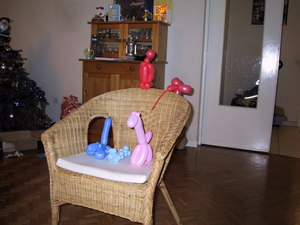
Back at Christmas, one of the presents that Thomas got was a box of balloons and a pump, and a small book explaining how to make balloon animals.
Being a good father, I decided to have a go 🙂
It took me a while to get things right – a lot of balloons ended up getting burst, but I finally got some reasonable results.

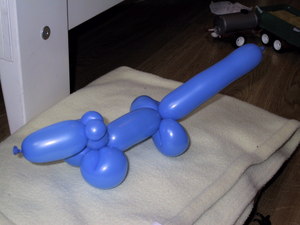
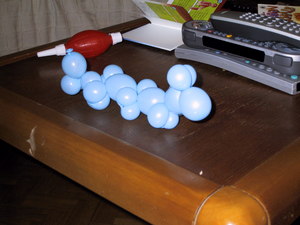
I also had a few disasters – this is a mouse in progress that lost an ear, but didn’t completely burst:
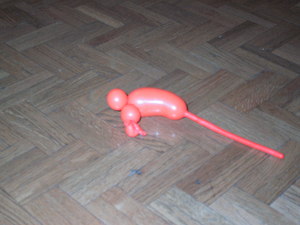
And I practiced ear twists and lock twists on this one, about which Anne commented “Looks like haemerrhoids”:
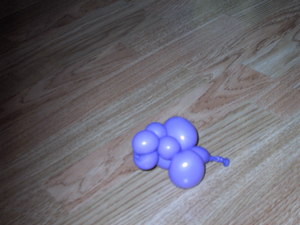
But in the end, the parrot, the crocodile, the centipede, the hummingbird and the giraffe were my pride & joy.
Some interesting stuff I’ve read recently:
I’ve noticed that companies are seting up different forums and clubs to standardize/promote/develop Linux/open source based technologies for mobile/consumer/embedded devices. I have my doubts… I do not fully understand how they plan to work. I’d go directly to places like the kernel.org or to GNOME to get things agreed, aligned, and -the most of all- developed. These are the communities that do the actual work and I’m not sure how these additional forums add value.
I’m starting to wonder if we in the open-source community need a grass-roots effort to address patent and license issues… [the] effective and realistic means to protect the health of the open-source development model and community is to take a page from the corporate playbook.
A bunch of updates since last month:
FOSTEL
FOSTEL went really well – attendance was over what I expected, but we still had enough food & drinks for everyone (thanks to the very generous “traiteur”) and the content of both the presentations and BOFs was pretty good. A smidgin more organisation, and a round of introductions to start off the conference (which I wanted to do, and promptly forgot) would have been perfect.
As it was, I spent all my time running around sorting out last-minute issues, although I did get to have a good chat with some people, particularly over dinner. It was particularly good to see Craig Southeren and Jochen Topf, who have been giving me help with the conference from a distance.
I am still waiting to attend a free software conference where no-one has any trouble with the projector, though.
Roll on FOSTEL 2007 in Germany.
OpenWengo
We’re still in a heavy pre-release push for OpenWengo’s next release of the WengoPhone (I know, I know, I didn’t choose the names). Marco Marongiu talked to myself and Philippe Bernery from the project to ask us a little about the project’s past, present and future on the cusp of a major release.
Tendonitis
In spite of some early optimism from my tendonitis (it’s funny now that 3 weeks ago I was still wondering whether I’d be able to run the marathon), a short 2km run and the advice of my physiotherapist put paid to any hopes I had of doing any serious running for quite a few weeks. In addition, I haven’t had the chance to do any biking for the last couple of weeks either, and I’m starting to feel some of that condition going. Hopefully I’ll still manage to be fit for a 10k in a couple of weeks so that I can at least do some running when my friend Dennis comes over.
GNOME board
As usual, lots of stuff is happening with the board, and as usual, there’s much of it that we can only allude to in the minutes. And a couple of people aren’t happy with the level of secrecy in the board.
It’s a tough problem because in the same way that a developer doesn’t necessarily want to release his code until he’s got a working first prototype, if I’m working on something through the board, I’m not going to announce it to the entire membership until it’s reasonably consequential – to boot-strap things, you get buy-in from important companies & community members and nail down important elements of whatever it is you’re working on before going public.
One example where I’ve been confronted with this was when I worked on getting a GNOME store in place by getting a preferred merchandising supplier – in the end, I went public when we were still in contract negociations with someone, which then fell through (for a number of reasons). Would it have been better to keep quiet about the project until I was certain of success?
Profile
Why anyone would want to profile me, I don’t know, but back in February, I sat down with Joe Brockmeier in SCALE and chatted to him about my free software past and more. We got a bit waylaid back then, and followed up by email. The result was the bass for a profile of me which came out on linux.com recently.
As some have noticed, I’ve been running for the past few months, training for a marathon at the end of April.
Since I started running, I have had a series of injuries – Achilles tendon from running uphill, a tendonitis in the groin from not stretching my hamstrings and adductors enough, and now, ITBS.
It’s another tendonitis which you get from running too long on a slanted surface, or poor posture during running, or pronation in your gait. Not sure which I did, although the doctor said I was fairly straight and he didn’t see any pronation, so it could be hip rotation, worn shoes, or just not changing footpath often enough.
The long & short of it is that whenever I run more than 10 or 15 minutes, I get knee pain. It’s nothing major, but it can take weeks to treat properly, so the chances are I’ll have to say goodbye to my marathon this time around… I am not giving up quite yet, but it’s not looking good.
Anyone reading this ever recovered from ITBS (syndrôme de l’essuie glace, ou tendinite du tenseur du fascia-lata en français) within 6 weeks of running a marathon? If so, what’s your secret?
For many years, the GNOME Foundation has had pro-bono legal help through Wilson, Sonsini, Goodrich & Rosati – they have helped us with a lot of issues from drafting trademark usage guidelines and contracts through auditing our bylaws and lodging trademark registration papers.
But some issues have needed an in-depth knowledge of our project, our values and our community. Treademarks in particular is an area where the interplay between copyright, trademark and community is particularly sensitive, and needs expert knowledge of free software as well as expert knowledge of the law.
Last year, we welcomed the SFLC onto the GNOME advisory board as a non-profit advisor. The foundation and SFLC announced today that we have now become the SFLC’s newest client.
We will continue to use WSGR’s services for most of our legal needs, but for anything which touches on our stature as a free software project, we will now be able to call on the very special expertise offered by the SFLC.
Thanks are due to Luis Villa for proposing this idea and bringing the parties together, and Anne Oestergaard for finally bringing things to conclusion.
