September 25, 2008
community, maemo
2 Comments
To follow on from various discussions and the unfortunately short BOF we had on this subject in Berlin, Ryan Abel (who couldn’t make it to the summit) suggested holding an informal IRC meeting to talk about the next steps in the maemo.org revamp.
The IRC meeting will be at 19:00 UTC on Saturday the 27th of September, on the #maemo-meeting channel on irc.freenode.net.
After the Summit, I believe that the basic elements of the changes we want to make are now well understood. Our dual goal is to reorganise existing information to provide the most relevant information to people who are coming to the site from outside the community, while catering to the different needs of people who are long-time members of the community. We’re going to do this by reorganising existing content where possible, rather than attempt to completely redesign the site.
September 22, 2008
General
12 Comments
For those of you wondering what the motivation behind that last post was (and for the benefit of one commenter, it’s not because I’m voting McCain – I’m an Irishman living in France), it’s because I’ve been growing increasingly disillusioned with the level of discourse in this election.
Most of the Americans I know (democrats) seem to be concentrating on the ultra-polarisation of the candidates their facing – there’s a consistent attempt to show how dumb McCain & Palin are (and similar attempts coming from the other side), how radical conservative ultra-Christian she is (“burning books! Dinosaurs in schools! Handing out automatic weapons to third graders!”) and so on.
On the other end, conservatives are trying to paint Obama as the no-experience, tax-and-spend (as opposed to reduce-tax-and-spend Bush) ultra-liberal Democrat, with Biden sticking his foot in his mouth every day.
The truth, and the election discourse, is not well served by this. We are discussing minutiae, not what’s most important.
I don’t care whether Gov. Palin knows what the Bush Doctrine is – I want to know if she agrees with it.
I don’t care if McCain knows what the name of the Spanish Prime Minister is (although I must admit, transcripts of that exchange are bewildering) – what I do want to know is how he will act when president, what his priorities are, the factors which will influence his decisions, whether he values human rights more than national security – in brief, his moral fibre.
For the record, it appears to me like the moral fibre is on the side of Barack Obama. The man is, aside from being charismatic and a great speaker, thoughtful in his reflections, and seems to me to have his heart in the right place when it comes not just to America, but to the world.
That’s what I want to find out. Where is your heart.
John McCain’s heart seems firmly set on the White House, his “put America first” mantra implying, of course, that Obama won’t. On that point, I think he’s right. I believe that if America’s interests are at odds with the interests of the world, Obama will do what’s right.
September 22, 2008
General
14 Comments
I find it amusing that we hold our politicians to standards that 99% of our citizens could not meet in terms of knowing stuff which usually figures as useless trivia. “Who is the prime minister of Spain?”, “How many soldiers in an army brigade, and an army battalion?”, “What is the Bush Doctrine?”, “How many chucks would a wood chuck chuck if a wood chuck could chuck wood?”
It reminds me of programming job interviews where people think that questions like “What is the difference between an inner join and an outer join?” or “How do you do an XSLT transform using Xalan and Xerces?” are good measures of how good a programmer you’ll be.
Try measuring what decision people will take when faced with a big difficult dilemma, rather than whether he knows the answer to a question which 30 seconds in Google would get him. That seems to me to be a better measure of presiding skills.
September 19, 2008
community, freesoftware, maemo, work
4 Comments
Coming to the end of the first day of the Maemo Summit in C-Base in Berlin. From just outside, you have a view of the antenna of the space station that the C-Base group have been mapping out for the past few years. For those who don’t know, this is the terraforming space station which brought life to earth, and which crashed in what is now Berlin 4.5 billion years ago. Only the central tower, now in use as a television tower, is visible above ground.
The two days in OSiM World were useful and educational. I got to meet people from companies trying to learn how to work well with Free Software, which gave a great opportunity to affect real change by talking to the decision makers in those companies. I also got to meet some Maemo people who came to OSiM to meet up and hang out at the Maemo/Nokia stand (by far the most active stand in the conference, by the way).
But the Maemo Summit is a refreshing counter-weight to that – some of the observations that people made this morning were:
- We got better wireless and power for free than at the high-powered conference people paid thousands of euros to attend (given that the CCC is involved in C-Base, that was not surprising to me)
- The vocabulary has totally shifted. We’ve moved from value propositions, cost-benefit analysis, return on investment and fragmentation to people getting excited about tracemonkey, PowerVR, OMAP3, Clutter, hacks, crashes and bugs… the people who are down in the trenches and know what free software is are here.
- Less suits, more t-shirts
It has been an amazing day so far – some big news from Peter Schneider this morning that the interface for the Fremantle will be Clutter based – Rodrigo Novo went into more details: Nokia are funding new tablet-oriented widgets and off-screen support for GTK+, the integration of Clutter, and more.The lightning talks were fascinating for the breadth and depth of things which people are doing with Maemo – everything from using them in police cars to porting PyPy through running Debian in a chrooted environment as a Maemo application (presentation given in OO.o running in said Debian on an N810!!!).
As usual, what’s most impressive at these things is meeting old friends and making new ones. I’ve got to spend lots of time with Stormy, Paul Cooper, Jim Zemlin, Lefty, Bdale and others, and today I had a chance to have a good chat with Rob Taylor, Philippe Kalaf, Murray Cumming, Simon Budig and more. I was very happy to put a face to Tero Cujo’s name, the latest addition to Nokia’s maemo.org team. I’m a little disappointed not to have met anyone from Nemein here yet after working with them for so long – but Henri is in Korea for an international Haedong Kumdo competition, and getting his 23rd Dan (or something like that) confirmed by a master while there.
In addition to the summit, there is also a desktop search hackfest happening over the next two days, with people involved in Tracker, Beagle and Xesam getting together to agree on interfaces and work on implementation, to bring rocking search to desktops and tablets of the future.
There’s a heavy GNOME influence at the conference, which makes the various noises I hear about Nokia backing away from GNOME seem exceedingly over-stated. It looks to me like Nokia are using more and more of the GNOME and freedesktop.org stack, and are more than any other company right now setting a direction for GNOME in the future with investments in technologies like Clutter.
So far, great stuff! Looking forward to the party tonight, and day 2 tomorrow.
September 18, 2008
community, maemo
2 Comments
Last night, “the Roaming Gnomes”, a team I put together, participated in the ACCESS pub quiz at OSiM World, organised by Lefty Schlesinger.
Lefty ran a Jeopardy-type quiz which was raucous, fun, energetic, competitive, and replete with a Windows Vista crash and a Flock bug. A bunch of teams had a go at questions in categories that included “Open source personalities”, “Comics and Movies”, “Mobile industry history”, “History of computing” and some general knowledge categories. And in the end, the best team won.Us! (Update: Now includes a photo of the winning team – Bdale and Jim got shy, and Niels had to leave early, and I think it’s Heikki who also missed the photo).
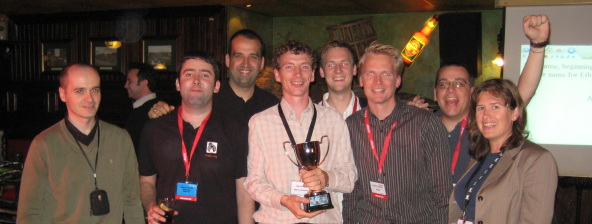
The Roaming GNOMEs
So here’s the role call of the Roaming Gnomes heros who helped bring the huge trophy to GNOME.
- Dave Neary
- Stormy Peters
- Paul Cooper (a two-time winner!)
- Alejandro, Alberto and Juanjo of Igalia
- Thomas Jansson
- Richard Rojfors
- Heikki Paajaken
- Bdale Garbee (our resident computing historian)
- Jim Zemlin
- Niels Breet (special mention for knowing the answer to which country has a wife-carrying race)
Congratulations to Lefty on running a very successful quiz – it was a good range of questions, and the rules change mid-game definitely contributed to the animation of the competition. And thanks once more to all the members of the team.
September 15, 2008
community, freesoftware, maemo, work
2 Comments
On Thursday I’ll be participating in a panel at OSIM World – “Effectively Building and Maintaining an Open Source Community”. It was a happy coincidence when I saw Matt Asay writing about the issue on Friday, and again today – it gives me a chance to think a bit more about the issues involved, and provides a data point which is very close to the experience that I have repeatedly seen when companies decide to use free software, be it peripherally or strategically.
On several occasions I have seen a lone developer decide to use a free software library to do some job for him. It doesn’t quite fit his needs, but he hacks up the extra feature or two in a couple of days, finds a few bugs that he fixes along the way to make things work as he needs them to, and ships it to a client as part of a larger solution.
At this point, one of two things will happen. The external project either stays as-is in the SCM of the company, awaiting a future upgrade request from the client, or the developer (usually because he is “the Linux guy” in the company and knows about these things) bundles up a couple of patches, heads along to the bug database for the project, signs up for Yet Another Bugzilla Account, and creates three or four bug entries with bug fixes attached, and another one for the new feature he hacked up. All told, he spends maybe half a day cooking up patches, navigating account creation, and submitting his work.
Usually, the patches will sit there for weeks or months before being reviewed. In most projects, if you don’t go onto a mailing list or IRC channel and ask the right guy to take the time to look at them, you can expect to wait. He has a backlog, gets lots of bugzilla nag mail already, and anyway, he’s working on a new feature he wants to get done this weekend between playing with the kids and doing the grocery shopping.
When they do get reviewed, the code base is likely to have shifted, so the patches don’t apply cleanly. Perhaps they don’t conform accurately to the coding conventions of the project. The feature, while useful, was done quickly (since it was only a minor part of a larger project), wasn’t accompanied by unit tests, and has a couple of issues that need resolving.
Of the four or five bug reports that our hacker created, one gets marked INVALID, another one is a DUPLICATE, and one patch gets applied and the bug fixed. The feature request status gets set to NEEDINFO, since there are some open issues to be addressed, but our hacker is now 6 months away from the code, 3 projects down the line, and has less time to write unit tests, review and resubmit the code.
Maybe he’ll do it anyway – and maybe he won’t.
In fact, I would say that the vast majority of the features people code up for free software projects never make it into an upstream bugzilla – developers are perfectly happy shipping a 10 year old version of GNU Kermit with hairy patches sticking out all over the place. And of those patches that do make it into an email or bugzilla, a small percentage ever make it into the upstream code base.
I would argue that when a project is strategic to a company product (as Lucene is to Alfresco), then the company has every interest in having someone who is regularly contributing to the project, who knows the key people in the community, and who is a trusted member of the community themselves. This ensures that your code is getting the care and attention it deserves when submitted upstream, and helps contribute to reducing your maintenance cost long run (as well as giving you influence over a project you depend on).
All this is to say that reducing the argument to “throw code over wall bad, participate good” is slightly over-simplifying – in the case where the project is a core part of your business, I agree wholeheartedly. If you’re using free software libraries as product, and merely tweaking to your needs, then the cost of participating outweighs the benefits in most cases. Reducing that cost by lowering the barrier of entry to participating is key to developing a vibrant community. But increased availability and a very low barrier to entry also incurs a cost on the community. Like most community-related issues, the balancing act is not an easy one to get right.
September 11, 2008
maemo
4 Comments
With the Maemo community council elections over, I’d like to congratulate the newly elected council. Good luck to Eduardo Lima, Andrew Flegg, Ryan Abel, Simon Pickering and Tim Samoff, who will make up the inaugural community council.
The council serves for a six month term, so they have a big job in front of them to define its role, and ensure it’s relevant to the Maemo community for years to come.
September 10, 2008
General
10 Comments
After pvanhoof opened the floodgates earlier, I guess I’ll follow up with some thoughts from across the pond…
McCain’s spent the last 8 months being painted by the hard-right nuts in the US republican party as an independent moderate Republican – I think this is an election ploy to make him appeal more to the swing voters.
And now, McCain’s chosen Palin as his VP pick. Where some people see a woman, I don’t think that’s why she was picked. She’s anti-abortion, pro-guns, anti-environment (she doesn’t believe that global warming has been proven, and even if it has, doesn’t believe it’s man-made): all in all, she’s a woman who has nothing in common with Hillary Clinton, and has no chance of picking up any disillusioned Clinton democrats. Sure, she appeals to the right wing of the party, and will consolidate the base.
What’s been interesting after this pick is the way the entire election campaign framing has changed. What people see in Sarah Palin is inexperience. And that’s suddenly become the centerpiece of the election.
The republicans are masters at framing the discussion, at making the democrats play defense. Kerry was a flip-flopper, Gore and Bush were “essentially the same”, the list goes on.
The Republicans almost always win when the most important thing in the campaign isn’t actually the candidate’s platform.
And so, by picking Sarah Palin, McCain’s trapped the democrats. “She’s inexperienced”, they say. “She’s got more experience than Obama”, say the republicans. “Biden’s got more experience than her”, say the Democrats. “McCain’s got more experience than Obama”, say the voices in the voter’s heads.
When you put Obama against McCain and measure experience, McCain wins. When you allow the debate to be framed as “who’s got the experience?”, Obama loses.
What the Democrats need to do is talk less about experience, and more about what you do when elected, where you want the country to go. “I may not have the experience of my opponent, but that just means I haven’t had to cut as many deals as he has,” he should say. “I haven’t had to compromise my ideals. I know where I want to take this country, and it’s a good place, where we take care of our sick, give our children the education they need to survive in the world, and where we use our position as a world leader to make the world a better place, instead of bullying the regimes we don’t like.”
If he speaks to their hearts, Obama will win.
September 8, 2008
gnome, maemo
No Comments
The Maemo community council election has been running for 5 days now, and voting closes at midnight Wednesday – I’ll be announcing the new council (subject to any contestations, protests, etc) on Thursday the 11th, one week before the Maemo community gets to meet in person in Berlin for the Maemo Summit.
If you think you should have a ballot, and you haven’t received one last Wednesday, please drop me a line.
If you have received a ballot and haven’t voted yet, please do so – there is only a little more than 2 days left to the election closing.
While I’m talking about the election, I’d like to thank GNOME for the election software we stole^Wborrowed and got working^W^Ware using for the election. I hope that the instructions which I wrote for the module are useful, and end up getting included in the foundation-web module.
Thanks also to Henri Bergius from Nemein, who got the software installed and has been my hands and eyes for the past few days on a server to which I don’t have access.
August 14, 2008
maemo
1 Comment
A couple of major things are happening around Maemo just before my holidays (oooh, scary) – first is that we recently rolled out some improvements to Maemo profiles – there are many new fields, including IM and IRC usernames, and the possibility to enter multiple email addresses for karma, and in general we prettied things up.
One new field is the company that people work for – and this is particularly useful in the newly spruced up profile ranking page – previously this page listed only usernames and karma, it now includes company and real name, allowing you to see at a glance where contributions are coming from. Of course, for this to be really useful, now that the fields are there, we need more people to fill them in 😉
The second big thing is the inaugural Maemo community council election. The entire Maemo community will be electing 5 people from among the most active community participants to represent the community’s interests to Nokia, and to co-ordinate community initiatives.
Nominations are open now – anyone with over 100 karma points can nominate themselves by sending a mail with their name, company affiliation and motivations for running to maemo-community@maemo.org before 23:59 UTC on the 2nd of September. The full list of eligible candidates is in the wiki.
« Previous Entries Next Entries »
