December 26, 2006
gnome
5 Comments
To answer the several people wondering abuot why we’re migrating to Subversion for GNOME, I have a few thoughts.
We’re currently using CVS, which ucks for a number of reasons which everyone agrees with. File moves, support for grouping changes to several files into one logical entity, efficient branching and tagging, versioned metadata – these are just some of teh features you expect from a revision control system that CVS doesn’t have. So moving to something else makes sense.
Of all the other version control systems, one (Subversion) has succeeded in fulfilling a number of criteria:
- Providing and communicating a migration route for CVS users – not just converting a repository, but also migrating your daily use from one to the other.
- Being included by default in pretty much every distribution.
- Generating copious documentation, making life very easy for repository admins.
- Providing an admin-friendly ACL permissions system for repositories.
- Providing a firewall-friendly way to get source code.
So there are a bunch of good reasons to move to SVN, and the only argument that people have against it is that “everyone knows that distributed’s better”.
For distributed systems, the observation I’d make is that there are several distributed revision control systems (bzr, baz-ng, svk, tla, Mercurial, git, …) so (assuming there’s agreement that’s the way to go) which one do you pick? Obviously there’s some argument about the Right Way to do distributed version control – otherwise, why so many to choose from?
Also, none of those systems has reached a level of maturity and acceptance that you can reasonably expect every developer to have it installed – so you’re adding an entry barrier (compiling the revision control system) for everyone who you want to build your stuff.
In short, the move to Subversion makes a lot of sense for GNOME, and a move to anything else would need a lot of good arguments backing it up before you could even consider it.
Bkor: One small correction – the board did not ask the infrastructure team to move to SVN – Jeff was the release manager at the time he asked, and it was in that capacity that he made the request. The board has never (in my memory) discussed version control systems.
December 20, 2006
General
6 Comments
After yesterday’s post, I went looking for one of those area-preserving maps I mentioned. Aside from the usual spherical and sinusoidal projections, I found out about the Dymaxion projection.
It’s an invention of Buckminster-Fuller, also famous for designing the Geodesic dome, and the Buckminster Fuller sphere (commonly known as the Bucky ball), which is now the classical geometry used for footballs, and who gave his name to the Carbon allotrope Buckminster-Fullerene (or C60) which has the same structure as the Bucky ball.
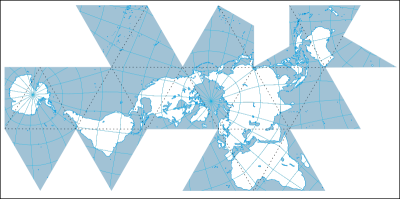
The globe is mapped onto an icosahedron, which almost eliminates distortion, and then unfolded to a planar surface. One interesting characteristic of the projection is that it’s possible to unfold the shape so that the continents are almost contiguously connected.
The other interesting thing is that once unfolded, it becomes obvious that Australia and Africa have almost exactly the same shape.
December 19, 2006
General
7 Comments
Recently, I’ve been seeing a bit more of the world – in recent months, I’ve been to Brazil and Portland, and over the next few months, I’ll be in LA, San José, Brussels and the UK, and probably more.
So now I get to answer questions from my eldest son Thomas like “Is Brazil near school, Daddy?” – I’ve come to realise that Thomas has no sense of the scale of the world.
So I decided to make the boys a globe light.
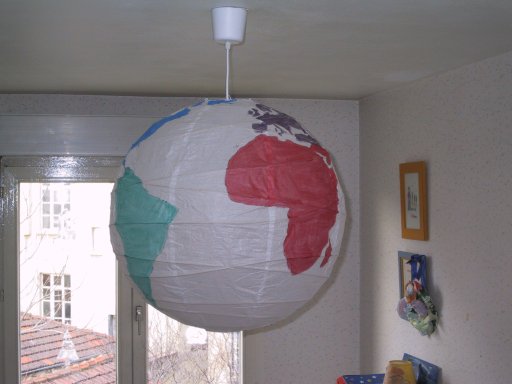
I bought a cheap paper ball light from Ikea and printed out a decent sized map of the world, drew some pencil guide-lines around the tropics, the equator and the arctic circle, and I was off.
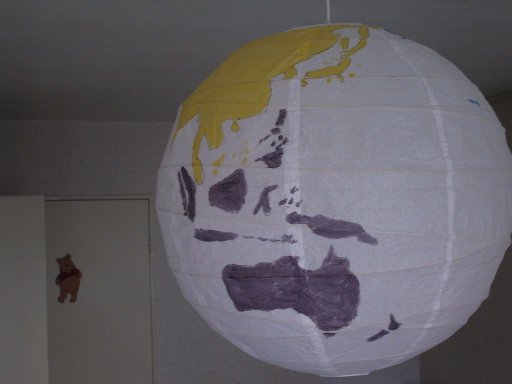
One of the things you learn when drawing a map is how little land is below the equator. The really interesting bits are at the top – so much so I almost hung the world upside-down just to see what it would look like.
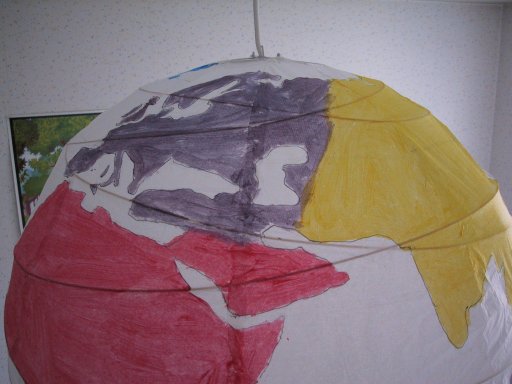
Another of the things you learn is that you will always draw the bits of the world you know better than the rest (see Europe). Australasia in particular is a pain to draw – what with Japan, Malaysia, the Philippines and Indonesia, it’s just a bunch of these tiny interlocking islands.
Also of note are some controversial colouring decisions – Turkey is in Europe on my globe, and part of Malaysia is in Australasia, while the rest is in Asia. No need to write in about these – they were simply convenience decisions on the spur of the moment.
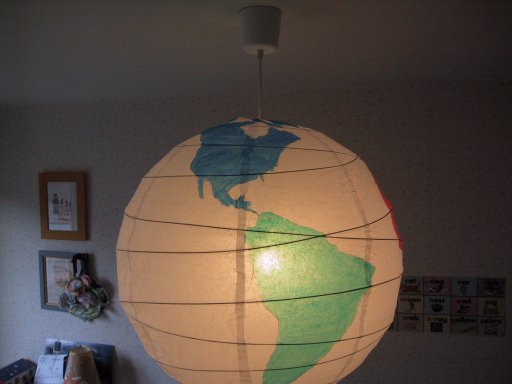
Another thing you notice when you try to draw things to scale is how stretched Europe and the US are in our classical world maps. I know that there are map types which preserve area, but I guess that we don’t use them much because people aren’t comfortable with how small Europe is.
December 18, 2006
gnome
1 Comment
A while back, I asked the list administrators to create a mailing list for me, which I have been meaning to get populated by chasing down everyone I know who should be on it. Unfortunately, circumstances have conspired against me doing taht the proper way, so now I’m resporting to a blog broadcast and an email to foundation-list 🙂
The mailing list I created was discussed at the marketing BOF in GUADEC: the GNOME User Groups masters list – modelled on the UK’s lugmasters list, this list will regroup representatives of various user groups around the world, to encourage collaboration and planning, sharing of information, organising common actions where useful, sharing experiences and generally making the GNOME Foundation aware of all of the things that are going on around the world.
The list will also be useful in the other direction – often, the foundation is contacted about an event where GNOME should probably be present, and we forward the mail on, but a central place to make sure people are informed what’s going on would be useful – it will also be useful to finally this year have a significant GNOME involvement in Software Freedom Day.
So – if you are involved in a GNOME User Group, and would like to know what others are trying, or co-ordinate an event with your neighbours, sign up – I expect to see at least one person from all the user groups on the wiki by Christmas.
For information, this mailing list will be ruled by my iron hand, and I will insist on people respecting the Code of Conduct.
In unrelated news, I got re-elected to the GNOME Foundation board – thank you to everyone who voted for me, I think we’re going to have a great year. Congratulations also to Quim, Jeff, Glynn, Vincent, Anne and Behdad. Participation this year was slightly up on last year (211 out of 346 = 60% versus 47% last year) – is this a sign that the board is doing better, or a side-effect of the membership renewal problem last month?
December 12, 2006
wengo
Comments Off on OpenWengo summit
I just announced that Wengo will be hosting a summit of contributors to the OpenWengo project on the 18th and 19th of January. The OpenWengo Summit will be our first opportunity to meet, get to know each other, and plan the future of the project.
It’ll be in Paris, in the offices of Wengo which has a great night-life and some fairly run-of the mill sights to see.
More information is available in the OpenWengo wiki.
December 11, 2006
gnome, wengo
2 Comments
I got home from Portland yesterday afternoon – I’m really starting to feel the jet-lag now. It’s only the second time I’ve had that much of a difference in time-zones, and I’m currently a time-zombie.
I’ve had a chance to reflect on the last few days, and have come to a conclusion. It was good, but not great. We had some more break-outs on Friday, and I had some great out-of-band conversations with people I’ll definitely be hooking up with very soon.
In no particular order, here are a few things I noted during the conference:
- The Wall of Laptops is evil in this kind of meeting
- Quim Gil said to me last GUADEC that there’s a Spanish saying that all work should be done with food on the table (or something like that) – and I can confirm that most of the valuable connections were made during breakfast, coffee breaks, and dinner & drinks
- The presentations should really have been 5 minutes per project – 10 minutes max – self-censorship was sorely missing
- It was a pity that we were missing some projects which made it difficult to make good headway on some issues – we discussed packaging and installing 3rd party software and improving upstream/downstream co-operation, but most of the distributions weren’t well represented, for example
- I was sorry Aaron Seigo didn’t make it
- I am hugely optimistic about audio after the audio session – perhaps inappropriately. We’ll see
- A couple of the break-out sessions were unfortunately rat-holes – there was no real resolution possible (at least, with the participants involved) – talking about DRM and codecs support for example was depressing
I was also involved in a discussion about what we need for ISD documentation, which was pretty aligned with what people have been saying around GNOME – we need to focus more on tutorials and coherent developer stories, rather than API docs (which are pretty good). Someone coming to GNOME should have access to code snippets showing how to use the APIs for more complex tasks. And we should have a book on GNOME development.
December 8, 2006
wengo
1 Comment
I’m in Portland for the Desktop Architects Meeting 3 at the moment, representing the OpenWengo project.
It’s been good – although the presentation sessions have been numerous, and have over-run, eating into break-out session time (which is what everyone is really here for).
Yesyerday, I was at the sound break-out, with people from Helix, Jack/ALSA, RedHat, Fluendo, LTSP, LSB and others. It was a good session, and took the right tack. We talked about what was needed to create an environment where we could solve the sound problem on Linux.
For those who aren’t aware of the sound problem on Linux, the problems
are that you have about 6 or 7 sound APIs you can develop against, and none of them work nicely together; all of them support some subset of the use-cases that ISDs creating sound apps need, and those subsets all overlap in some way; there is no agreement on what the scope of a sound API and sound system for Linux should be.
The end result for the user is that when you go to a web page that includes flash, your music player stops working, or your browser freezes up until your music app quits, or any other number of issues that are created when different apps use different sound APIs.
It should be noted that pretty much everything is possible right now – with at least one API.
So the first goal is to work out that scope – agree on use-cases that should be enabled in the basic sound API, and work out how we can move from where we are now to a place where all of those use-cases are possible with a high-level sound API.
The plan for that is to get all of the actors involved together on a mailing list, including application developers, platform developers, distributions and low-level sound APIs. We need agreement on the sound story – the use-cases and scope, and have at least one face to face meeting to work out how to go from talk to action, and hopefully between now and next year, we should have something which ISDs like us can use and know that things will Just Work.
I unfortunately missed a second break-out on packaging, installation, dependency management and upgrades – choices are horrible.
A second set of break-out sessions is planned today – looking forward to going to an ISD session, if we have another one.
December 1, 2006
gnome, marketing
2 Comments
Without much ado, the Free Software World Conference has been getting itself together for next year. The conference will take place in Badajoz (updated) in Extremadura (the home of LinEx) on the border with Portugal. The dates are set for the 7th to the 9th of February.
It might be a hard place to get to, but the conference got such a good review last year and the year before that I’m hoping to go. But with SCALE happening on the 10th and the 11th, that might be hard to pull off.
The Call for Papers is open (but only available in Spanish at the moment) until the 15th of January. It would be really great to have some GNOME oriented presentations there. I have no doubt that José Angel is already on the case 😉
November 23, 2006
gnome
Comments Off on Newsbruiser problem
Elijah: you need to set a password (assuming this is the same problem Calum and I had).
November 21, 2006
gnome
Comments Off on Fear of losing
Dom: Fear of failure can be a big issue getting anything done, and failing publicly is even more scary.
For what it’s worth, last year I think you lost because of the way you came into the race – as a negative candidate disagreeing with a referendum decision. Given the work you’ve done on legal issues for the foundation this year, I think you would make a great board member, and I’m sorry you didn’t run.
« Previous Entries Next Entries »