January 29, 2007
openwengo
Comments Off on KDE hackfest in Wengo offices
We have some guests in the office today – David Faure, Laurent Montel, Benoit Jacob, Eric Pignet and Laurent Rathle from KDE (and KDE France) dropped by for a hackfest working on KDE 4. I did everything I could to slow them down, of course, but they were having none of it.
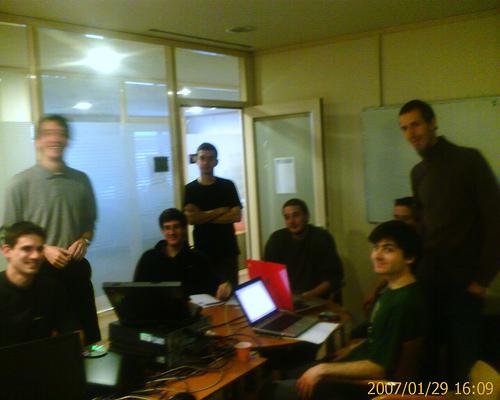
It was good to meet people from the KDE side of the fence, and David even gave us a presentation on some of the new stuff in QT 4, which was very well received by all involved.
Wengo is a proud sponsor of the KDE stand during Solutions Linux this year – drop by their stand if you want to see a demo of the latest releases of KDE or the Wengophone (if we manage to have working network).
January 26, 2007
openwengo, work
Comments Off on OpenWengo summit – one week on
(Reposting from the OpenWengo blog)
Last week, the Openwengo developers (with a couple of notable exceptions due to exams) got together in Paris, and we had a great time.
Some of the photos taken over the two days by Aurélien Gâteau are now up on Flickr (finally! I hear you cry).
Among the highlights of the two days were having 25 people stuffed in a tiny meeting room for 2 hours (in this photo, half of the people have gone outside to faint), going on an antique carousel under the shadow of the Eiffel Tower before taking a guided boat tour on the Seine, and having a lovely meal in “A la Pomponette” on Montmartre without Antoine (you know what I’m talking about).
We also managed to get a lot of work done – it’s rare that a development team takes the time to sit down and think about where we’re going for two days, and the feedback that we got over the two days will enrich the project for many months to come. It was really great to meet up with people like Didier, Lukas, Séven and Vadim, who have been involved in the community for ages, but who I had never met before.
And it was great to meet new faces like PH who just came along to meet everyone and ended up taking great notes of everything that happened, or students like Florian and Stéphane,from Calais, Ludovico and Livio from Turin, Tristan, our usability expert, and Yann, a former Code Camper who worked on IAX support during the Summer.
Among other attendees were of course the Wengo employees working on OpenWengo – Tanguy Krotoff, party animal as ever, Sébastien Tricaud, Philippe Bernery – the master of CoIP, our new plug-in framework for OpenWengo, Minh Phan who maintains our copy of phapi, and all of the others in the team.
Thanks to everyone who came, I hope you all had as good a time as I had.
January 26, 2007
gnome
Comments Off on Documentation survey
Andy Oram asked me to pass this on – and since he’s been giving us advice on GNOME docs, I’m happy to do so (very mercenary of me, I know).
Do you answer questions on mailing lists about how to use a
software tool or language? Do you write documentation, put
up web pages, or contribute to wikis about software? If so,
please take this survey to help O’Reilly do
research that will be published on the O’Reilly web site,
and may help software projects and communities get more such
contributions.
They’re only interested in hearing from people who do this for
non-monetary reasons.
I guess if you’re being paid to write docs, your primary motivation is assumed to be your pay-check.
January 16, 2007
gnome
6 Comments
I wanted to congratulate Julien, Christian et al at Fluendo on the release of their codec bundles this week. According to the arstechnica article:
Fluendo’s codec release is bound to stir up controversy and generate criticism within certain segments of the open-source community. A small but vocal minority of Linux users vehemently oppose the commercial sale of proprietary codecs for the Linux platform since such codecs limit user freedom and impede open redistribution. Critics are likely to perceive the sale of codecs as validation of proprietary software business models and a tacit rejection of open-source ideals.
Au contraire, I think it’s great that a company is offering for-money sale of commercial codecs – it’s infinitely preferable to “free” codecs that people are downloading and using – often in non-compliance with the GPL (“but that’s OK, we download them separately, and we’re not redistributing the aggregate work”).
People should realise that proprietary codecs are just that – proprietary. And if they cost money, that’s a great way to realise.
I wish Fluendo all the best with their shop.
January 11, 2007
gnome
4 Comments
GNOME is not a project which is independent of commercial interests, as much as we fancy ourselves as that.
On the contrary, commercial interests are all around us – several modules change maintainership when the maintainer leaves a company, and most of the committers on many modules come from one or two companies.
The question, then, is not how we go about integrating commercial interests into the project, but how we mould the commercial interests already in the community so that they are community-friendly. The best way to do this is to first recognise the existing commercial forces, and to evolve the project so that GNOME can become a true center of collaboration and communication.
January 9, 2007
General
3 Comments
No particular motivation for this, but it’s probably something everyone in free software (and IT in general) should re-read every 6 months or so: An open letter to other men in the movement by Dan Spalding.
January 8, 2007
gimp
5 Comments
This is quite possibly the most impressive GIMP plug-in I have ever seen.
Previous favourites gimpressionist, IWarp and GREYCstoration fade into the shadows when compared to this magic stuff.
January 5, 2007
gnome, marketing
1 Comment
I just sent a request for proposals from user groups to the gugmasters mailing list. The board needs to know how much help user groups need for the year to budget properly, and although we will leave some slack for ad hoc last minute requests, having lots of info up-front will be very useful.
Anyone working with a user group who would like to make a proposal should sign up to the gugmasters list today, and help us out. Thank you!
January 5, 2007
home
10 Comments
It is with great pleasure that I present to you the newest member of the Neary family, which, while waiting for a real name to be chosen (once we know whether he’s a he or a she) will be known by the codename “toto”.
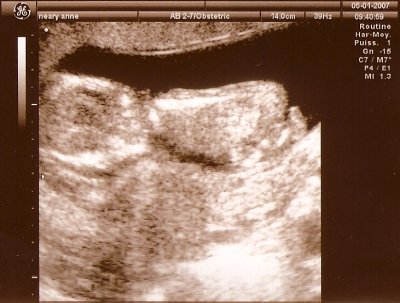
We had the first scan today, and everything is perfect. If anyone who hasn’t seen one of these needs directions, ask in the comments, I’ll let you know where all the bits are 🙂
Update: It seems some people thought that this was going to be my 5th child – I can confirm that the 5 includes myself and Anne – that’s 3 kids. Isn’t that enough?
January 4, 2007
General
7 Comments
One of the most controversial blog posts I’ve written here hasn’t been about software, it’s been about French property prices.
I recently bought some shares (for the first time) and following share prices has caused me to think about why investing in property is such an attractive proposition.
The answer is leverage.
The way leverage works is simple – if I invest €100 of my own money into something, and it goes up in value by 5%, I make €5, or a 5% return on investment. If I invest 10 euros of my own money, borrow €90, it goes up 5%, and I reimburse €92, I’ve made €3, or a 30% return on investment.
Mortgages work the same way – if I buy an apartment for €150,000 and resell it for €200,000, then the more I have borrowed from the bank, the greater (in percentage terms) my return on investment.
Investments which go the other way also magnify the effect – in that initial example, if I put €10 of my own money, and I lose 5%, when I’ve paid back €92, I’m left with only €3, a loss of 70% of my capital. I can also end up in debt if the investment loses any more than 8% of the initial value.
How do people get leverage for investments other than the property market? I have no idea. I would love to find out, though. Anyone have any tips?
« Previous Entries Next Entries »
