Blog

  • Needinfo bugs

    I’m trying to make Bugzilla not bother developers about the bugs that are not important (or having to follow every bugmail closely). One example is the needinfo bugs. As long as a bug is in the needinfo state, you should not be bothered with it.

    Hiding these needinfo bugs caused a few problems:

    • Reporters didn’t reopen needinfo bugs
      Logically, reporters should not have to know that needinfo bugs should be reopened if the requested information has been given. However, this wasn’t made clear. Elijah changed GNOME Bugzilla a while ago so that anyone changing a needinfo bug will be asked if they provided the requested information. When answering yes, the bug will be reopened.
    • Needinfo bugs being forgotten
      Sometimes bugs can be fixed faster/easier when the reporter provides extra information, but with extra work the developer could fix it. If a developer doesn’t notice needinfo bugs anymore, that extra work will never happen.

    Bugsquad triaged 1439 needinfo bugs that haven’t been changed in over 3 months. In less than a week around 1100 bugs where closed as incomplete or ‘reopened’. An old copy of the weekly bug summary shows just how many bugs have been closed (copy of the top 15 bug closers for 7 days):

    Position Who Number of bugs closed
    1 Andre Klapper 399
    2 Olav Vitters 314
    3 Baptiste Mille-Mathias 114
    4 Karsten Bräckelmann 87
    5 Charles Kerr 37
    6 Fabio Bonelli 35
    7 Christian Kirbach 35
    8 sven gimp org 16
    9 Matthias Clasen 15
    10 Aaron Bockover 15
    11 David Trowbridge 14
    12 Brent Smith (smitten) 12
    13 Gustavo Carneiro 12
    14 Tim-Philipp Müller 12
    15 Victor Osadci (Vic) 11

    To avoid these needinfo bugs being forgotten in future, I’ve added a needinfo overview to browse.cgi which shows per last changed period the number of needinfo bugs. This way you can easily see the number of needinfo bugs changed in the last 2 weeks, or how many haven’t been changed in over a year. It still needs a bit of UI work to clearly show that this overview is the only part where needinfo bugs are shown. I actually made this patch a week ago, but I had to fight with SELinux to make changed files be shown by Apache. Not knowing anything about SELinux a week ago solving this took a bit of time. It seems to work now, although I do not understand why at first it didn’t and now it does. It seems to me that initially patch and cp in a directory changed the security context and suddently it does not. Oh well.

    Debugging symbols
    Usually bugs are marked needinfo because the stacktrace is not good enough. I would be very happen if someone either:

    • Figured out a way to make bug-buddy ask for and automatically download+install the debugging symbols for some of the distributions. It does not have to work for all distros. Just one ‘major’ distro would be enough. Want to solve this? See bug 331004.
    • Figure out a way to have a few common distros installed in a chroot on a server, make bug-buddy send the core file (or whatever) to that server, then generate the stacktrace with the debugging symbols and make a bugreport for it. Hopefully after checking for duplicates first 😉
    • Change http://live.gnome.org/GettingTraces to be more understandable for the someone who only noticed some dialog popping up asking for their email address (meaning bug-buddy).

    I hate marking these bad stacktraces as needinfo or closing them as incomplete. I fully understand 99.9%+ of the users not understanding what we want from them when given the GettingTraces link. Some distributions not even have debugging symbols for all packages, making it even worse. I hope this problem can be resolved by one or more persons looking at the relevant bug-buddy bug: bug 331004. Another way would be providing GNOME packages (rpms/debs) as part of the Build Brigade.

    Bug aliases
    A while ago somebody discovered bug aliases. Using this field you can give a name to a bug. When duping, marking depends/blocking another bug instead of entering the bug number, you can just fill in the bug alias. It also works for show_bug.cgi. Loading http://bugzilla.gnome.org/show_bug.cgi?id=gtkbuilder will show bug 172535. I received a request if I could make http://bugs.gnome.org/gtkbuilder redirect to http://bugzilla.gnome.org/show_bug.cgi?id=gtkbuilder as well. I did that this weekend and made it work for both bugzilla.gnome.org as well as bugs.gnome.org. The bug alias must match ^[A-Za-z0-9]+$ for this to work.

    And best for last: I joined the GNOME sysadmin team
  • Switch to subversion at 23:59 UTC

    As announced a while ago GNOME will switch to Subversion starting TODAY at 23:59 UTC. See http://live.gnome.org/Subversion and a FAQ at http://live.gnome.org/SubversionFAQ. I actually forgot it was today already, so I’m guessing others did as well.

  • Likely almost all bugmail lost between 10:00 and 20:00 UTC

    Very likely almost all bugmail has been lost between 10:00 and 20:00 UTC today (being July 11th). Due to a mailserver configuration error only people with a @gnome.org address could receive bugmail between this period. This includes new account emails, etc.

    I made a quick query to show the 202 new and changed bugs between this period:
    this query

    Note that this query uses the last changed date. So as soon as the bug is changed again it will disappear from this list (this is on purpose).

    Update: Whoops! Used the wrong month in the query

  • TARBALLS DUE: GNOME 2.15.4 Development Release

    Tarballs are due on Monday July 10th (this Monday) before 23:59 UTC for the GNOME 2.15.4 Development Release, which will be delivered on
    Wednesday. If for some reason you are not able to make a tarball before Monday, please send a mail to the release team: they can find someone to roll the tarball for you!

    After July 10th the following announcement periods begin:

    • String Change Announcement: All string changes must be announced to both gnome-i18n@ and gnome-doc-list@.
    • UI Change Announcement Period: All user interface changes must be
      announced to gnome-doc-list@.

    Modules which were proposed for inclusion should try to follow the 2.15 schedule so everyone can test them.

    For more informations about 2.15, the full schedule and the official
    module lists, please see our shiny 2.15 page on the wiki:

    http://live.gnome.org/TwoPointFifteen

    To help write good release notes, please add major user-visible changes
    happening during the 2.15 release cycle to this wiki page:

    http://live.gnome.org/TwoPointFifteen/ReleaseNotes

    Usually these announcements go to devel-announce-list and gnome-hackers, but as I still haven’t seen the email pop up after 9 hours…

  • Bugzilla will be DOWN Friday 7 July 2006 21:00 UTC

    Bugzilla will move to a different server on Friday 7 July at 21:00 UTC. If you want to know what time that is for your location, look here. The move should not take more than 30 minutes, including DNS update (refresh time has already been shortened to prepare for the move). For those with broken DNS servers I will announce another name here + on the old server to reach bugzilla.gnome.org after the move has been completed (it will not work reliably before everything has been moved over).

    I am now an upstream Bugzilla developer. Checking their Getting CVS Write Access feels a bit overwhelming. Getting GNOME CVS access was much easier (ok, I just dislike the faxing part).

  • Feeds from blogs.gnome.org

    The software behind blogs.gnome.org (NewsBruiser) has an interesting default. By default the feeds only give the entries for the current month. So if you make a post minutes before a month ends, likely no planet will show your post.

    I couldn’t really understand how I could fix this safely (without breaking other stuff), so I’ve added a hack instead. The feeds from blogs.gnome.org will now always show the last 15 entries. There is some code in there so you can get a feed specific for a year. This is probably broken now.

    I checked the server logs and nobody seems to be using anything but the standard syndication URL, so above hack shouldn’t cause any problems. If you find your feed is broken, please file a bug. And please post a patch as well 😉

    A few more patches I made for Bugzilla (official one, not b.g.o) have been accepted. Bugzilla 2.24 (or the not-yet-released 2.23.2) will now have a preference to control the initial state of the ‘Add me to the CC-list’ checkbox. By default it is checked unless you have a role (reporter/assignee/qa contact) on the bug.

    An important patch is one that detects if the user is trying to submit the same bug multiple times. This could happen if a user refreshes the post_bug.cgi page. Due to some dynamic content on the post_bug.cgi the obvious fix (redirect to show_bug.cgi) could not be done. The patch will give a warning when the users tries to submit the same bug again (for more details, read the bugreport).

    Another one that was accepted a while ago adds a X-Bugzilla-Watch-Reason. It changes the existing X-Bugzilla-Reason header to only contain the reasons why you are on a bug (Assignee, Reporter, etc). If you are only watching people on a bug, X-Bugzilla-Reason will contain None (handy for filtering). The X-Bugzilla-Watch-Reason will contain None if you are not watching anyone on the bug. If you are watching someone it will contain the reasons and also the email addresses you are watching. I plan to merge this patch into bugzilla.gnome.org soon (currently we do differ between being a role and watching a role, but it all ends up in X-Bugzilla-Reason).

    LpSolit (Bugzilla developer) is currently working on moving the CheckCanChangeField function from process_bug.cgi to Bugzilla/Bug.pm. This function checks if the current user is allowed to change a field (priority/version/summary/etc). When this is done I’m going to change the show_bug.cgi template to use this function and only allow the user to change the fields they are allowed to change. The end result will be like on bugzilla.gnome.org, except on b.g.o I hard-coded the permissions in show_bug.cgi, while the upstream version will use the same function for the UI as well as the backend.

  • Bug-buddy usage

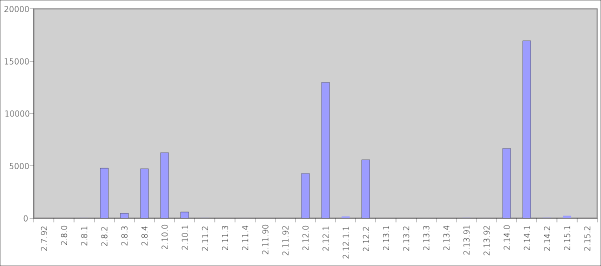
    When Bug-Buddy starts it will check if it needs to update its configuration files. It does this maximum once per day by checking the time of three XML files on bugzilla.gnome.org.

    From the bugzilla.gnome.org webservers logs I grepped the hits to one of these files. Each hit will contain the gnome-vfs version that was used to access it. A pretty safe assumption is that the gnome-vfs version is the same as the GNOME version.

    Per GNOME (gnome-vfs) version I now have the number of hits generated during a month of data. Again, Bug-Buddy only checks once a day and the hit is only done when someone starts Bug-buddy (eg app crashes and you click the ‘Inform Developers’ button).

  • Bugzilla, Bugzilla, Bugzilla

    On the main page of bugzilla.gnome.org there is an image of a bug:

    image of a -hard to recognise- bug

    I do not like that image. Could someone please design a better one and attach it to bug 339216?

    Another thing I hate is the color used for quoted text (#ad7fa8). I chose that color so that I could make the first person who complained responsible for giving a better one. Unfortunately no one complained. Still want a better (non-blueish) color.

  • GUADEC Goal(s)

    The #1 thing we must have at GUADEC is the following:

    I’ve already informed him that his attendance is mandatory, but I think we need more aggressive methods to actually make it happen. I’m mainly looking for a kidnapping expert, but other suggestions are also welcome.

  • GNOME performance tip

    Run ‘fc-cache -f’ as root and as a normal user. Usually a distribution runs this when needed, but for some reason Mandriva didn’t (or there was some other problem). This caused all apps to start very, very slowly.

    In GNOME 2.13.latest as described elsewhere the multimedia keys have been removed from the Keyboard Shortcuts capplet. You now need to correctly select your keyboard in the Keyboard capplet → Layouts → Keyboard model to make the multimedia keys work. Pretty annoying as I want the Play/Pause to work as a Pause key, not Play as GNOME/xorg thinks it is. Having that key set to Pause will make Audacious correctly switch between Play/Pause. But as removing the support fixes a major bug (ignoring modifiers like ctrl/alt when selecting ctrl-alt-p, allowing normal keys like ‘P’ to be used and not ‘unbinding’ the key to make ‘P’ work again) I can understand why it was removed.