• GUADEC 2013, Day 4

    The final core day of GUADEC began with a keynote by Cathy Malmrose. Cathy is CEO of ZaReason, which sells computers pre-installed with Linux. She talked about the goals of ZaReason: to provide beautiful, high-end computers that can be freely used. ZaReason machines are used by FedEx, NASA’s jet propulsion labs and Stanford’s AI Lab, among many others, and uses local shops for assembly and support.

    Cathy spoke passionately about the affinity between ZaReason and GNOME, and her desire for a closer working relationship. She said: “To thrive F/LOSS must be part of the hardware chain. Hardware & software must work together.” For her, GNOME has all the pieces and has produced an incredibly valuable codebase that she wants to support.

    Then it was time for talks. Juan Pablo Ugarte presented CSS support in the Glade interface designer. There were cheers when he revealed that he had created his presentation slides – which included animated backgrounds – purely using Glade, which even let him export to PDF. Alejandro Piñeiro Iglesias and Joanmarie Diggs also spoke about their work on PDF tagging, which improves formatting and accessibility.

    Stef Walter’s “More secure with less ‘security’” provoked an extremely positive reaction. He talked about plans to improve the security of GNOME software while also enhancing the user experience. As Stef talked, the auditorium Twitter wall filled up with comments like “A sudden outbreak of common sense!” and “Stef talks gold”. At the same time, Anish Patil and Mike Fabian gave a talk on their recent predictive input methods, which allows an input method to automatically complete words as the user types. They described how necessary it is to have effective features like this for parts of the world like indea, where there are more than 25 languages.

    After lunch, Martin Robinson gave a talk on the work done to integratie WebKit2 into GNOME for version 3.8. This was a major undertaking, and brought new features and enhancements to the platform. Martin and Carlos discussed some of these, and gave advice to application authors on how to best take advantage of them. In the other room, Marta Maria Casetti presented her work to produce guides and tutorials for new programmers working with GNOME technologies. Giving his second talk of the conference, Jeff Fortin Tam presented the latest development work on Pitivi, a GNOME video editor application.

    The end of the day – and the final session of the core days – was interns’ lightning talks. A large audience gathered to hear about the many projects that have been undertaken by interns on the Outreach Program for Women and Google Summer of Code. A huge number of topics were covered, including dual screen presentation mode in Evince, a new GNOME avatar picker dialog, work on geolocation support, PitiVi, GCompris, redesigned Date & Time settings, a new Maps application, focus and caret tracking in the screen magnifier feature, a new sound recorder application, a major upgrade to Cantarell (the GNOME font), porting color management to Wayland, folder encryption support in Nautilus, search and selections in the new Music application and an F-Spot faces tool. There was a round of applause when we heard that one of the interns has taken over maintainership of the GNOME Dictionary. We also saw the return of Richard Schwarting’s Foxy mascot.

    As the core day came to a close, the conference organizers took to the stage and were given a huge standing ovation for all their work. Many of the conference attendees then embarked on a walking tour of Brno, which gave them a chance to see some more of the city and learn its history.

    Photos courtesy of Garrett LeSage.

  • GUADEC 2013, Day 3

    GUADEC is still going here in Brno. The conference has switched modes from days of presentations to a busy schedule of working sessions. This is the first of our reports on what happened over the weekend, starting with Saturday 3rd August.

    As the temperature continued to rise, the conference continued at full force. A drone was seen flying around the venue, and attracted a lot of attention. The Twitter walls in each of the auditoriums also continued to be the subject of much hilarity as people posted their comments during the talks.

    Day three’s keynote was a question and answer session with the newly elected GNOME Foundation Board of Directors. We spent an hour talking about the Foundation’s plans for the coming year, and had a productive discussion about how to improve our marketing and public relations efforts. Then we were into talks once again.

    First up, Srinivasa Ragavan spoke about Evolution as an email service, while in the other room Emily Gonyer spoke about FLOSS & Education. Srinivasa explained the plan for splitting Evolution into a mail data service which could serve emails to other applications. He also demoed a working email factory as well as a small application using Evolution as a service. Emily Gonyer described her home schooling experiences and talked about how children can learn using computers from an early age. She also talked about the importance of teaching children to use computers creatively and not purely to consume commercial products.

    Next, Philip Withnall, spoke about testing GNOME components that use online services. He described his work to enable diagnosis and recording of the interaction between local libraries and servers. At the same time, Jan-Christoph Borchardt gave a presentation about how GNOME and ownCloud can work more closely together. Jan, who is a designer working on ownCloud, spoke about the opportunities for syncing data between GNOME and the cloud. His motto: “Just. Sync. Everything.” He also spoke about the importance of protecting users’ privacy, which is a goal shared by GNOME.

    After lunch, Bruno Cardoso Lopes introduced LLVM and Clang. GNOME indirectly uses LLVM through the llvmpipe software rendering engine, and the Gedit Code Assistance Plugin also uses Clang to assist coders with helpful messages and compilation hints. Bruno explained several beneficial and potential uses of LLVM and Clang by GNOME, for example the LLVM LTO and interprocedural optimizations, the Clang static analyser, and the LLVM ARM backend.

    Marina Zhurakhinskaya gave a report on the progress of our fantastically successful Outreach Program for Women, which is now offering internships for women with 16 different organizations. Aleksander Morgado and Carlos Garnacho explain the basics of Tracker and gave practical SPARQL examples and tips about how to use the database. At the same time, Ekaterina Gerasimove gave the annual “Documentation State of the Union Talk”: a summary of the last year’s documentation work, and the team’s plans for the future. Zeeshan talked about GNOME’s new geolocation framework, called geoclue2, as well as the new GNOME Maps application. Maps uses data from OpenStreetMap, and can determine your location using a variety of mechanisms, such as Wi-Fi, and GPS.

    Jeff Fortin Tam gave a fun talk about managing bug databases, called “Extreme containment measures: keeping your bugs under control”. His talk contained lots of practical strategies and tips on keeping your bug count low, and getting the most out of your bug reports. In the other auditorium, Sriram Ramkrishna and Andrea Veri gave a report on the activities of the GNOME Sysadmin Team.

    The day ended with the first of our lightning talks sessions. A host of presenters gave short talks on a wide variety of subjects, including EasyTag, Boxes, gettext, Cantarell, measuring display latency using Arduino, the words of Jane Jacobs.

    In the evening, Mozilla generously funded a party at the local Starobrno brewery. Much fun was had by all.

  • Call for hosts for GNOME.Asia Summit 2014

    The GNOME.Asia Committee is inviting proposals to host the GNOME.Asia
    Summit during the 2nd quarter of 2014. The GNOME.Asia Summit is the
    featured annual GNOME Conference in Asia. The event focuses primarily
    on the GNOME desktop, and also covers applications and the development
    platform tools. It brings together the GNOME community in Asia to
    provide a forum for users, developers, foundation leaders, governments
    and businesses to discuss both the present technology and future
    developments.

    GNOME.Asia Summit was held in Beijing, Ho-Chi-Minh City, Taipei,
    Bangalore, Hong Kong and Seoul respectively over the last six years.
    The Summit’s preference is to find new locations each year as we
    spread GNOME throughout Asia, and we are looking for local organizers
    to rise to the challenge of organizing an excellent GNOME event. The
    GNOME.Asia committee will assist in the process, but there is a
    definitive need for individuals to be actively involved and committed
    to the planning and delivery of the event.

    You can learn more about GNOME.Asia Summit at our official website:
    http://www.gnome.asia

    For those of you who would be interested in hosting the next
    GNOME.Asia Summit in 2014 you are hereby invited to submit a formal
    proposal to the gnome-asia-committee-list<at>gnome<dot> org . The
    deadline for the proposals is September 1, 2013. Please email your
    proposal to gnome-asia-committee-list<at>gnome<dot> org. We might
    invite you to present your proposal in more details over our regular
    IRC meetings, or send you additional questions and requests. Results
    will be announced by the third week of September, 2013.

    The conference will require availability of facilities for one week,
    including a weekend, during the 2nd quarter of 2014 (between March and
    June). Final event dates should avoid other key free software
    conferences or other events that may have conflict and will be
    confirmed together with other GNOME teams which might get involved.

    Key points which proposals should consider, and which will be taken
    into account when deciding among candidates, are:

    • Local community support for hosting the conference.
    • Venue details. Information about infrastructure and facilities to
      hold the conference should be provided.
    • Preliminary schedule with main programme & different activities.
    • Information about how internet connectivity will be managed.
    • Lodging choices ranging from affordable housing to nicer hotels,
      and information about distances between the venue and lodging options.
    • The availability of restaurants or the organization of catering
      on-site, cost of food/soft drinks/beer.
    • The availability and cost of travel from major Asian and European cities.
    • Local industries, universities and government support.
    • Please provide a reasonably detailed budget (sponsorships, expenses, etc).
    • Provide plans for fundraising at a local level.

    Please refer to the official web site of GNOME.Asia [1]. Please also
    check the GNOME.Asia Summit check list [2], howtos [3] and a winning
    proposal for the year 2012 [4] when putting together a proposal. Feel
    free to contact gnome-asia-committee-list gnome org if you
    have any questions.

    Please help to spread the words and we are looking forward to hearing
    from you soon!

    GNOME.Asia Committee

    [1] http://wiki.gnome.org/GnomeAsia
    [2] http://2011.gnome.asia/about/gnomeasia/event-organization-checklist
    [3] http://2011.gnome.asia/about/gnomeasia/summit-planning-howto
    [4] http://wiki.gnome.org/GnomeAsia/2012Summit/Bids?action=AttachFile&do=view&target=Proposal_of_HongKong_GNOME_Asia_Hackfest_2012_20120124.pdf

  • Meet GUADEC 2013

    There’s a motto in the GNOME Project: “GNOME is people”. GUADEC is the best place to experience that first hand: it is our chance to spend time with and enjoy the company of contributors. Meet GUADEC 2013.

    guadec-2013-1600

  • GUADEC 2013, Day 2

    The temperature rose once again in Brno today. Thirsty hackers were seen sheltering in the shade, while the local conference team shipped in extra water for all the participants.

    The day began with our second keynote of the conference, by Matt Dalio from Endless. Matt spoke passionately about bringing computers to the billions in the world who lack access to them, and his plans to utilize GNOME technologies to do so. It was an inspiring talk, which got an extremely positive response from the audience. During the talk, the stories of real people who currently don’t have access to computers and the internet were told, and Matt challenged the GNOME community to develop our software with their needs in mind.

    After the keynote, we once again hit the track rooms for another day of talks.

    First up, Emmanuele Bassi spoke about the future of Clutter, while in the other room, Tim-Phillip Müller talked about “What’s cooking in GStreamer”. Emmanuele talked about the current difficulties experienced by both Clutter and GTK+, and the plan to resolve these by merging them. The plan is to make Clutter internal an internal scene graph for GTK+. Emmanuele also issued a health warning for those searching for slide images on the internet. Since the GTK+ hackfest in April, some progress has been made here.

    Tim-Phillip described progress within the GStreamer project. He announced that the 1.2 release will be on time for GNOME 3.10, and that 1.4 will bring fewer new features, but more cleanup, QA, polishing and documentation improvements.

    GTK+ was a theme for today’s talks. After Emmanuele, Tristan van Berkom spoke about the UI developer experience with Glade/GTKBuilder. One of his key messages: “a good developer experience is one which reduces the steps involved in creating software.” He demonstrated his recent work with template widgets. We also heard about new work that will allow drag and drop repositioning of controls, and a demo of this raised a big round of applause. Matthias Clasen also gave a talk on GTK+, and showed the audience how to create a new application using GTK+3. This used the standard documentation which is supplied with GTK+, which provides a straightforward step-by-step tutorial

    In one of the last sessions of the day, Benjamin Otte gave his talk, called “GTK: To Infinity and Beyond”. He talked more about the plans described in Emmanuele’s talk, and spoke about the plans for the future. According to Benjamin, our new GTK+ widgets have well thought out APIs and are well tested. He also spoke about plans to ensure stability in GTK+ in the future.

    Wayland was another theme for the day. Robert Bradford gave a talk on Wayland, “the future of Linux graphics”. That was followed by a Wayland panel discussion, which included Robert, Owen Taylor and Kristian Høgsberg. Here there was much talk of the future and ongoing work to have GNOME 3 and applications running on the new display manager. Many of the details are being worked out, and GNOME is expected to be running on Wayland in the near future.

    Finally, we had the annual GNOME Foundation Annual General Meeting. Karen Sandler (the GNOME Foundation Executive Director) opened by welcoming new Foundation members, and encouraged everyone to attend the question and answer session with the Board of Directors on Sunday.

    Reports were given by each of the GNOME teams. Allan Day (design team), the Release Team (Andre Klapper), the Bugsquad (Andre Klapper) accessibility (by Juanjo Marin), localization (Petr Kovar), websites (Andreas Nilsson and Fabiana Simões), the membership committee (also Fabiana Simões), marketing (Emily Gonyere), outreach (Marina Zhurakhinskaya), system administration (Andrea Veri) and documentation (Sinhdu Sundar).

    There was lots of interesting news during the presentations…

    • Jasper St Pierre filed the most patches again for another year.
    • Strasburg is the capital of Europe
    • Our outreach efforts are going from strength to strength. GNOME now offers internships for women on behalf of 16 organizations.
    • GNOME 3.8 supported a total of 52 languages, thanks to the work of our localization teams.
    • Andrea Veri, the GNOME sysadmin, is the web team’s favourite person in the whole world (and got a big round of applause).
    • In 2012 we received more donations from individuals than in any other year previously.

    After that we had presentations from our new treasurer and Karen Sandler. And finally, the annual pants award was presented to Allan Day. We expect to see him wearing them for the rest of the conference.
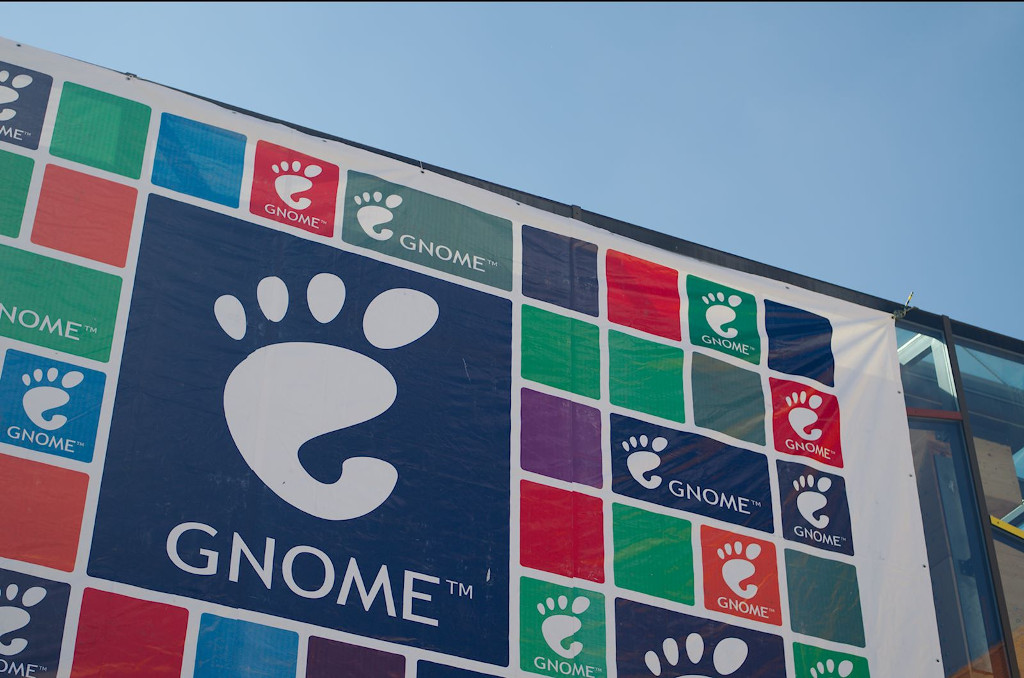
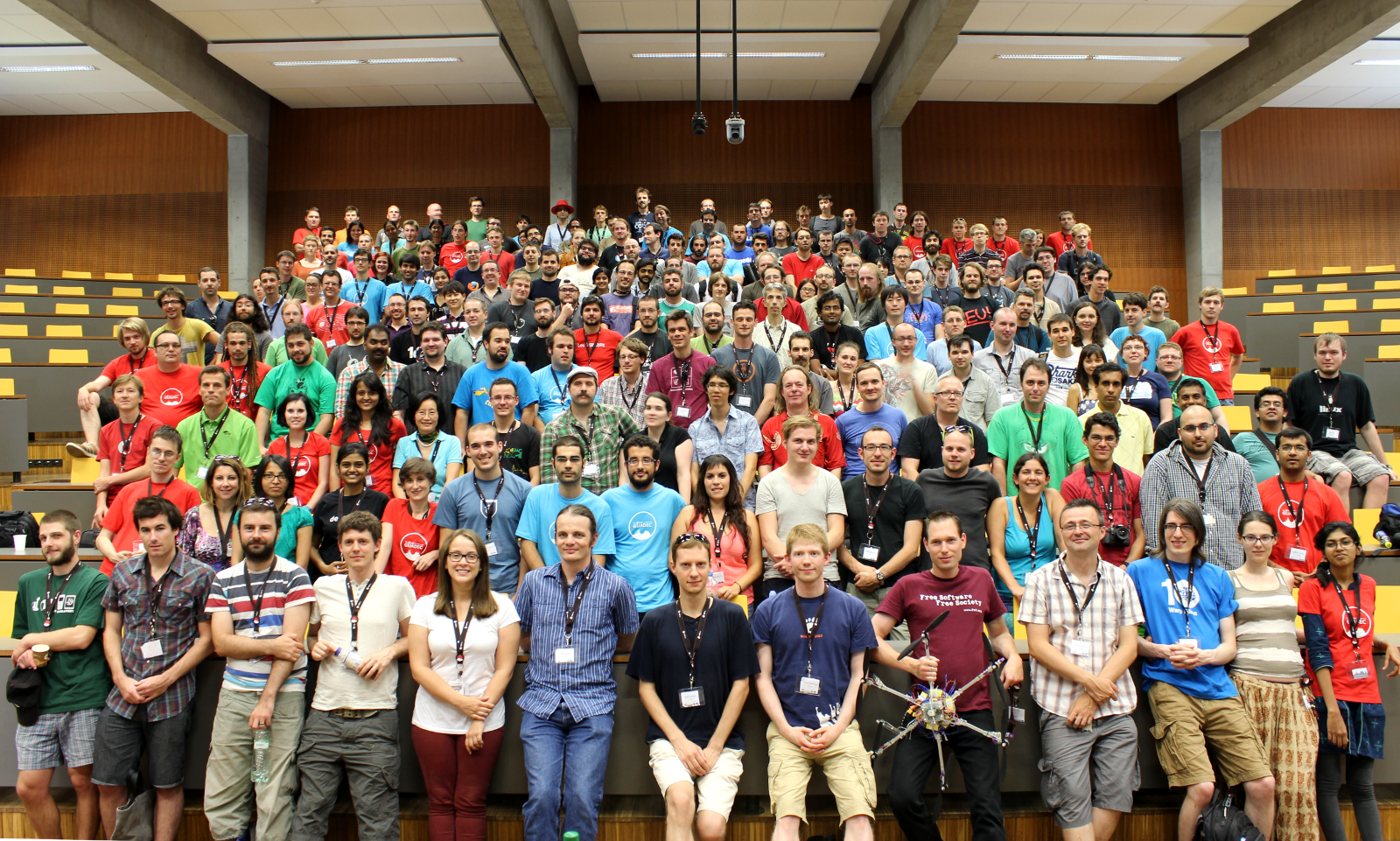
  • GUADEC Day 1 Gallery

    Photos from day 1 of GUADEC 2013.

    All images courtesy of Jakub Steiner.

  • GUADEC 2013, Day 1

    GUADEC 2013, GNOME’s annual European Conference, kicked off today in a warm and sunny Brno (Czech Republic). This is the main GNOME event of the year, and there are hundreds of contributors here for 8 days of talks and working events.

    Everyone arrived early for the conference opening by Karen Sandler. The venue for this year’s conference is the Faculty of Information Technology at the Brno University of Technology. It’s a lovely modern setting, integrated into a beautiful old courtyard. Lovely place to be on a sunny day. The rubber ducks floating in the fountain were a big hit.

    We also got started to a great piece of news, with Karen announcing that the Linux Foundation has joined the GNOME Advisory Board. Read more details on the news post.

    After that, we were off with a day of presentations. First up there was our first keynote, by Ethan Lee, who works on porting indie games to Linux. He spoke about the challenges of porting games to Linux, and how we can help by providing better tools and community support.

    Then the presentation tracks got started. We have two tracks this year, with 12 presentations by GNOME contributors on each day.

    Allan Day talked about the Future of GNOME 3, while in the other room Colin Walters gave a report no the progress of the OSTree project. Allan spoke about the values and aspirations behind the GNOME project, and its mission to provide software freedom for as many people as possilbe. Then he went on to talk about the progress that has been made on improving the GNOME 3 user experience, as well as next steps that are required to make things even better. In the other room, Colin Walters described how the OSTree project is improving the quality of GNOME software. This initiative means that code commits are booted and tested in a virtual machines just minutes after they have been made. He hopes to get this time delay down to mere seconds in the near future.
    Next up, Ekaterina Gerasimova and Sindhu Sundar gave an inspiring talk on getting started in GNOME. We also had an update on the status of the GNOME Web browser by Claudio Saavedra.

    After that it was time for lunch, where many of us got a proper Czech meal: goulash and dumplings.

    The afternoon included a diverse range of talks. Fabiana Simões spoke about to (and how to not) report usability and user experience bugs. Another talk about design was given by Jakub Steiner, who showed off the process behind his impressive animated 3D mockups.

    Lennart Poettering spoke to a very hot and packed auditorium about “Sandboxed applications for GNOME”. This was one of the most popular talks of the day. Lennart spoke about the progress to date, and set out a nine point plan for what needs to happen next.

    We also had a number of talks on community building and outreach. Flavia Weisghizzi talked about the challenges faced by new contributors. She argued that we need to make women contributors more visible, and that we need to offer more support and mentoring opportunities. She described the fantastic progress that GNOME has made including women in the project: 17%, compared with 5% in Ubuntu and 2.5% in Debian. Sri Ramkrishna spoke about his ongoing outreach efforts. His advice: be sincere, be patient, make complainers into doers by filing bugs and contributing to the project. Meg Ford also gave a talk about outreach, and described here work to build a GNOME group in Chicago.

    At the end of the day, Alex Larsson demonstrated his new hi-resolution display support work for GNOME 3. Brian Vibber, who donated a laptop to help with this work, got a round of applause from the audience.

    GUADEC 2013 has got off to a fantastic start. There is a great atmosphere here, and lots of new contributors. Expect more posts in the coming days.

  • GNOME publishes the GNOME Outreach Program Yearbook 2013

    GNOME Outreach Yearbook 2013Over the last years, the GNOME Outreach Program made several improvements to its central projects, the Outreach Program for Women and Google Summer of Code. Some of these improvements are making sure each intern connects with a potential mentor ahead of time, contributes a patch to the relevant module as part of the application process, and has blog posts with progress updates incorporated on Planet GNOME. All of these requirements were made to help students and interns to connect to their projects early on.

    This year, we continued the tradition of a yearbook with the GNOME Outreach Program Yearbook 2013. In this book, you will find all participants from the Outreach Program for Women January-April 2013, the Outreach Program for Women June-September 2013 and Summer of Code 2013 . Furthermore, all students and interns who will be at this years GUADEC are highlighted with a badge. Please take the time to get to know our newest contributors!

    Download the GNOME Outreach Program Yearbook 2013

  • Linux Foundation Joins the GNOME Advisory Board

    Opening GUADEC 2013 today, Karen Sandler, GNOME Executive Director, announced that the Linux Foundation has become the latest member of GNOME’s Advisory Board. The Advisory Board is a body of stakeholder organizations and companies who support the GNOME Project by providing funding and expert consultation. It includes IBM, Google, Intel and the Free Software Foundation, among others.

    Speaking at the opening of GNOME’s annual European conference (GUADEC), Sandler said: “We are excited to have the Linux Foundation join our Advisory Board, and look forward to working closely with them. Their membership in the Advisory Board is a recognition of the value that the GNOME Project brings to the GNU/Linux ecosystem, which is something that we hope to enhance even further in the future.”

    Joining the GNOME Advisory Board will give the Linux Foundation the organization a direct voice within the GNOME Project and will enable it to play a greater role in the future of GNOME.

    Jim Zemlin, Executive Director of the Linux Foundation, said “Our mission to promote and advance the Linux kernel is aided by our partnerships with key free software projects. GNOME is an important project and we are looking forward to continued collaboration by joining the advisory board.”

    Dan Frye, who is Vice President of Open Systems Development at IBM and is also a board member of the Linux Foundation said, “This is an opportunity for two longstanding influential organizations in the open source community to work together. The Linux Foundation and GNOME have complementary goals, missions, and skills. This relationship should help both organizations and the entire community.”

    Read the press release

  • GUADEC 2013 Begins in Brno, Czech Republic

    751px-Fakulta_informačních_technologií

    It’s off the IRC channels and mailing lists and into the halls of the Brno University of Technology for over 200 GNOME users and developers this week. GUADEC, GNOME’s annual European conference, kicks off today in sunny Brno where members of the GNOME community are convening to discuss and develop GNOME technologies, meeting old friends and make new ones.

    GUADEC 2013 will take place August 1 through August 8 with 4 keynotes, 80 presentations and 4 working days of hackfests and BoF (Birds of a Feather) sessions. Stay tuned for our daily digests of the events happening across the conference.

    Read more in our press release.

    [Image by Jan Symon (Jan Symon) [CC-BY-SA-3.0], via Wikimedia Commons]

This work is licensed under a Attribution-NonCommercial-ShareAlike 3.0.