• Announcing Our First Fellows

    The GNOME Foundation has selected the first recipients who will receive funding through its new Fellowship program, and is delighted to announce that Peter Eisenmann and Sophie Herold will begin work as our first Fellows in July.

    Sophie and Peter are both long-running GNOME contributors, with many significant contributions as members of the GNOME community. Sophie is known as developer of apps, libraries, and websites, including Loupe, Pika Backup, Glycin, and welcome.gnome.org. Peter is a long-standing Nautilus maintainer (officially known as the Files app), as well as an experienced contributor to platform libraries, including GTK and GLib.

    Both Fellows will spend time working to enhance the long-term sustainability and health of the GNOME project. Sophie will be working to establish a new RFC process for GNOME, which will enhance our project-level governance. She will also be working on more maintainable and secure libraries through Rust adoption. Peter will work to modernize many aspects of the Files app, including thumbnailing, user directory localization, and the use of modern GNOME platform conventions.

    Congratulations to Peter and Sophie – we’re genuinely excited to see what you’ll achieve as our first Fellows, and proud to be supporting your work.

    We’d also like to take this opportunity to thank everyone who submitted applications to the first round of the Fellowship. We received some genuinely excellent proposals, and would strongly encourage unsuccessful applicants to apply again in future rounds.

    Peter and Sophie’s work is made possible by the generosity of GNOME’s supporters. If you’d like to help fund future rounds and support contributors like them, please consider donating.

  • Introducing the GNOME Fellowship program

    Sustaining GNOME by directly funding contributors

    The GNOME Foundation is excited to announce the GNOME Fellowship program, a new initiative to fund community members working on the long-term sustainability of the GNOME project. We’re now accepting applications for our inaugural fellowship cycle, beginning around May 2026.

    GNOME has always thrived because of its contributors: people who invest their time and expertise to build and maintain the desktop, applications, and platform that millions rely on. But open source contribution often depends on volunteers finding time alongside other commitments, or on companies choosing to fund development amongst competing priorities. Many important areas of the project – the less glamorous but critical infrastructure work – can go underinvested.

    The fellowship program changes that. Thanks to the generous support of Friends of GNOME donors, we can now directly fund contributors to focus on what matters most for GNOME’s future. Programs such as this rely on ongoing support from our donors, so if you would like to see this and similar programs continue in future, please consider setting up a recurring donation.

    What’s a Fellowship?

    A fellowship is funding for an individual to spend dedicated time over a 12 month period working in an area where they have expertise. Unlike traditional contracts with rigid scopes and deliverables, fellowships are built on trust. We’re backing people and the type of work they do, giving them the flexibility to tackle problems as they find them.

    This approach reduces bureaucratic overhead for both contributors and the Foundation. It lets talented people do what they do best: identify important problems and solve them.

    Focus: Sustainability

    For this first cycle, we’re seeking proposals focused on sustainability work that makes GNOME more maintainable, efficient, and productive for developers. This includes areas like build systems, CI/CD infrastructure, testing frameworks, developer tooling, documentation, accessibility, and reducing technical debt.

    We’re not funding new features this round. Instead, we want to invest in the foundations that make future development and contributions easier and faster. The goal is for each fellowship to leave the project in better shape than we found it.

    Apply Now

    We have funding for at least one 12-month fellowship paid between $70,000 and $100,000 USD per year based on experience and location. Applicants can propose full-time, half-time work, or either – half-time proposals may allow us to support multiple fellows.

    Applications are open to anyone with a track record in GNOME or relevant experience, with some restrictions due to US sanctions compliance. A GNOME Foundation Board committee will review applications and select fellows for this inaugural cycle.

    Full details, application requirements, and FAQ are available at fellowship.gnome.org. Applications close on 20th April 2026.

    Thank You to Friends of GNOME

    This program is possible because of the individuals and organizations who support GNOME through Friends of GNOME donations. When we ask for donations, funding contributor work is exactly the kind of initiative we have in mind. If you’d like to sustain this program beyond its first year, consider becoming a Friend of GNOME. A recurring donation, no matter how small, gives us the predictability to expand this program and others like it.

    Looking Ahead

    This is a pilot program. We’re optimistic, and if it succeeds, we hope to sustain and grow the fellowship program in future years, funding more contributors across more areas of GNOME. We believe this model can become a sustainable way to invest in the project’s long-term health.

    We can’t wait to see your proposals!

  • Join Friends of GNOME

    Join Friends of GNOME

    This post was contributed by the Fundraising Committee from the GNOME Foundation.

    This week we are launching an end-of-year fundraising campaign with a simple goal: to reach 1,500 Friends of GNOME by the end of the year. We need your help: become a Friend of GNOME today at donate.gnome.org!

    Why give?

    We are a nearly 30-year-old Free Software project whose contributors believe in building something greater than ourselves. We give our work and time freely so that the world benefits. We believe in a world where everyone is empowered by technology they can trust, and we help make that possible by tirelessly building a diverse and sustainable free software personal computing ecosystem.

    This past year has been full of highlights from the community, culminating in the GNOME 48 and GNOME 49 releases. You can also read all about what contributors have been shipping week after week in This Week in GNOME, which is submitted and curated by community members.

    The GNOME Foundation supports the GNOME project by providing infrastructure, services for contributors, development of Flathub, community travel sponsorship, events, and more. Giving to the GNOME Foundation helps ensure we stay sustainable for the future, enables us to invest more directly into the community and development, and ultimately helps GNOME deliver even more goodness to each and every user for free.

    Become a Friend of GNOME

    Thank you to existing Friends of GNOME, sponsors, and supporters

    Of course, we would like to thank our 744 existing Friends of GNOME and corporate sponsors for their recurring support, as well our advisory board members for their support and guidance. And thank you to the many organizations that support us in other ways, including with infrastructure.

    Join us in celebrating!

    This week, we will also be sharing and celebrating the accomplishments of GNOME and our contributors over the past year on social media. Be sure to follow #FriendsOfGNOME across our social media accounts:

    Finally, if you’re already a Friend of GNOME or join us this month, please share your story with #FriendsOfGNOME as well so that we can thank you!

  • GNOME Has a New Infrastructure Partner: Welcome AWS!

    This post was contributed by Andrea Veri from the GNOME Foundation.

    GNOME has historically hosted its infrastructure on premises. That changed with an AWS Open Source Credits program sponsorship which has allowed our team of two SREs to migrate the majority of the workloads to the cloud and turn the existing OpenShift environment into a fully scalable and fault tolerant one thanks to the infrastructure provided by AWS. By moving to the cloud, we have dramatically reduced the maintenance burden, achieved lower latency for our users and contributors and increased security through better access controls.

    Our original infrastructure did not account for the exponential growth that GNOME has seen in its contributors and userbase over the past 4-5 years thanks to the introduction of GNOME Circle. GNOME Circle is composed of applications that are not part of core GNOME but are meant to extend the ecosystem without being bound to the stricter core policies and release schedules. Contributions on these projects also make contributors eligible for GNOME Foundation membership and potentially allow them to receive direct commit access to GitLab in case the contributions are consistent over a long period of time in order to gain more trust from the community. GNOME recently migrated to GitLab, away from cgit and Bugzilla.

    In this post, we’d like to share some of the improvements we’ve made as a result of our migration to the cloud.

    A history of network and storage challenges

    In 2020, we documented our main architectural challenges:

    1. Our infrastructure was built on OpenShift in a hyperconverged setup, using OpenShift Data Foundations (ODF), running Ceph and Rook behind the scenes. Our control plane and workloads were also running on top of the same nodes.
    2. Because GNOME historically did not have an L3 network and generally had no plans to upgrade the underlying network equipment and/or invest time in refactoring it, we would have to run our gateway using a plain Linux VM with all the associated consequences.
    3. We also wanted to make use of an external Ceph cluster with slower storage, but this was not supported in ODF and required extra glue to make it work.
    4. No changes were planned on the networking equipment side to make links redundant. That meant a code upgrade on switches would have required full service downtime.
    5. We had to work with with Dell support for every broken hardware component, which added further toil.
    6. With the GNOME user and contributor base always increasing, we never really had a good way to scale our compute resources due to budget constraints.

    Cloud migration improvements

    In 2024, during a hardware refresh cycle, we started evaluating the idea of migrating to the public cloud. We have been participating in the AWS Open Source Credits program for many years and received sponsorship for a set of Amazon Simple Storage Service (S3) buckets that we use widely across GNOME services. Based on our previous experience with the program and the people running it, we decided to request sponsorship from AWS for the entire infrastructure, which was kindly accepted.

    I believe it’s crucial to understand how AWS resolved the architectural challenges we had as a small SRE team (just two engineers!). Most importantly, the move dramatically reduced the maintenance toil we had:

    1. Using AWS’s provided software-defined networking services, we no longer have to rely on an external team to apply changes to the underlying networking layout. This also gave us a way to use a redundant gateway and NAT without having to expose worker nodes to the internet.
    2. We now use AWS Elastic Load Balancing (ELB) instances (classic load balancers are the only type supported by OpenShift for now) as a traffic ingress for our OpenShift cluster. This reduces latency as we now operate within the same VPC instead of relying on an external load balancing provider. This also comes with the ability to have access to the security group APIs which we can use to dynamically add IP addresses. This is critical when we have individuals or organizations abusing specific GNOME services with thousands of queries per minute.
    3. We also use Amazon Elastic Block Store (EBS) and Amazon Elastic File System (EFS) via the OpenShift CSI driver. This allows us to avoid having to manage a Ceph cluster, which is a major win in terms of maintenance and operability.
    4. With AWS Graviton instances, we now have access to ARM64 machines, which we heavily leverage as they’re generally cheaper than their Intel counterparts.
    5. Given how extensively we use Amazon S3 across the infrastructure, we were able to reduce latency and costs due to the use of internal VPC S3 endpoints.
    6. We took advantage of AWS Identity and Access Management (IAM) to provide granular access to AWS services, giving us the possibility to allow individual contributors to manage a limited set of resources without requiring higher privileges.
    7. We now have complete hardware management abstraction, which is vital for a team of only two engineers who are trying to avoid any additional maintenance burden.

    Thank you, AWS!

    I’d like to thank AWS for their sponsorship and the massive opportunity they are giving to the GNOME Infrastructure to provide resilient, stable and highly available workloads to GNOME’s users and contributors across the globe.

  • GNOME Foundation Welcomes Steven Deobald as Executive Director

    The GNOME Foundation is delighted to announce the appointment of Steven Deobald as our new Executive Director. Steven brings decades of experience in free software, open design, and open documentation efforts to the Foundation, and we are excited to have him lead our organization into its next chapter.

    “I’m incredibly excited to serve the GNOME Foundation as its new full-time Executive Director,” said Steven Deobald. “The global network of contributors that makes up the GNOME community is awe-inspiring. I’m thrilled to serve the community in this role. GNOME’s clear mission as a universal computing environment for everyone, everywhere has remained consistent for a quarter century—that kind of continuity is exceptional.”

    Steven has been a GNOME user since 2002 and has been involved in numerous free software initiatives throughout his career. His professional background spans technical leadership, business development, and nonprofit work, and he was one of the founding members of Nilenso, India’s first worker-owned tech cooperative. Having worked with projects like XTDB and Endatabas and founding India’s first employee-own, he brings valuable experience in open source product development. Based in Halifax, Canada, Steven is well-positioned to collaborate with our global community across time zones.

    “Steven’s wealth of experience in open source communities and his clear understanding of GNOME’s mission make him the ideal leader for the Foundation at this time,” said Robert McQueen, GNOME Foundation Board President. “His vision for transparency and financial resilience aligns perfectly with our goals as we support and grow the diversity and sustainability of GNOME’s free software personal computing ecosystem.”

    Steven plans to focus on increasing transparency about the people and processes behind GNOME, reestablishing the Foundation’s financial stability, and building resilience across finances, people, documentation, and processes to ensure GNOME thrives for decades to come. You can read more from Steven in his introductory post on his GNOME blog.

    Heartfelt Thanks to Richard Littauer

    The GNOME Foundation extends its deepest gratitude to Richard Littauer, who has served as Interim Executive Director for the past ten months. Despite initially signing on for just two months while simultaneously moving to New Zealand and beginning a PhD program, Richard extended his commitment to ensure stability during our search for a permanent director.

    During his tenure, Richard worked closely with the board and staff to pass a balanced budget, secure additional funding, support successful events including GUADEC, and navigate numerous challenges facing the Foundation. His dedication to ensuring GNOME’s continued success, often while working across challenging time zones, has been invaluable.

    “I knew this day would come at some point,” Richard shared in his farewell post. “My time has been exceedingly difficult… I feel that I have done very little; all of the gains happened with the help of others.” Richard’s humility belies the significant impact he made during his time with us, creating a solid foundation for our new Executive Director.

    Richard will return full-time to his PhD studies at Te Herenga Waka Victoria University of Wellington, but remains available to the GNOME community and can be reached via Mastodon, his website, or at richard@gnome.org.

    Looking Ahead

    As we welcome Steven and thank Richard, we also recognize the dedicated contributors, volunteers, staff, and board members who keep GNOME thriving. The Foundation remains committed to supporting the development of a free and accessible desktop environment for all users around the world.

    The GNOME community can look forward to meeting Steven at upcoming events and through community channels. We encourage everyone to join us in welcoming him to the GNOME family and supporting his vision for the Foundation’s future.

  • GUADEC 2025 Registrations are Open!

    GUADEC 2025 Registrations are Open!

    The GNOME Foundation is thrilled to share that registration for GUADEC 2025 is now open!

    GUADEC is the largest annual gathering of GNOME developers, contributors, and community members. This year we welcome everyone to join us in the beautiful city of Brescia, Italy from July 24th to 29th or online! For those who cannot join us in person, we will live-stream the event so you can attend or present remotely.

    To register, visit guadec.org and select whether you will attend in person or remotely.
    In-person attendees will notice a slight change on their registration form. This year we’ve added a section for “Registration Type” and provided 4 options for ticket fees. These costs go directly towards supporting the conference and helping us build a better GUADEC experience.
    We ask that in-person attendees select the option they are most comfortable with. If you have any questions, please don’t hesitate to reach out to us at guadec@gnome.org.

    Register for In-Person Attendance
    Register for Remote Attendance

    The Call for Participation is ongoing but once are talks are selected you will find speaker details and a full schedule on guadec.org. We will also be adding more information about social events, accommodations, and activities throughout Brescia soon!

    We are still looking for conference sponsors. If you or your company would like to become a GUADEC 2025 sponsor, please take a look at our sponsorship brochure and reach out to us at guadec@gnome.org.

    To stay up-to-date on conference news, be sure to follow us on Mastodon @gnome@floss.social.

    We look forward to seeing you in Brescia and online!

  • Introducing GNOME 48

    The GNOME Project is proud to announce the release of GNOME 48, ‘Bengaluru’.

    GNOME 48 brings several exciting updates, including improved notification stacking for a cleaner experience, better performance with dynamic triple buffering, and the introduction of new fonts like Adwaita Sans & Mono. The release also includes Decibels, a minimalist audio player, new digital well-being features, battery health preservation with an 80% charge limit, and HDR support for compatible displays.

    For a detailed breakdown, visit the GNOME 48 Release Notes.

    GNOME 48 will be available shortly in many distributions, such as Fedora 42 and Ubuntu 25.04. If you want to try it today, you can look for their beta releases, which will be available very soon

    Getting GNOME

    We are also providing our own installer images for debugging and testing features. These images are meant for installation in a vm and require GNOME Boxes with UEFI support. We suggest getting Boxes from Flathub.

    GNOME OS Nightly

    If you’re looking to build applications for GNOME 48, check out the GNOME 48 Flatpak SDK on Flathub.
    You can also support the GNOME project by donating—your contributions help us improve infrastructure, host community events, and keep Flathub running. Every donation makes a difference!

    This six-month effort wouldn’t have been possible without the whole GNOME community, made of contributors and friends from all around the world: developers, designers, documentation writers, usability and accessibility specialists, translators, maintainers, students, system administrators, companies, artists, testers, the local GNOME.Asia team in Bengaluru, and last, but not least, our users.

    We hope to see some of you at GUADEC 2025 in Brescia, Italy!

    Our next release, GNOME 49, is planned for September. Until then, enjoy GNOME 48.

    :heart: The GNOME release team

  • Linux App Summit 2025 – Registrations are now open!

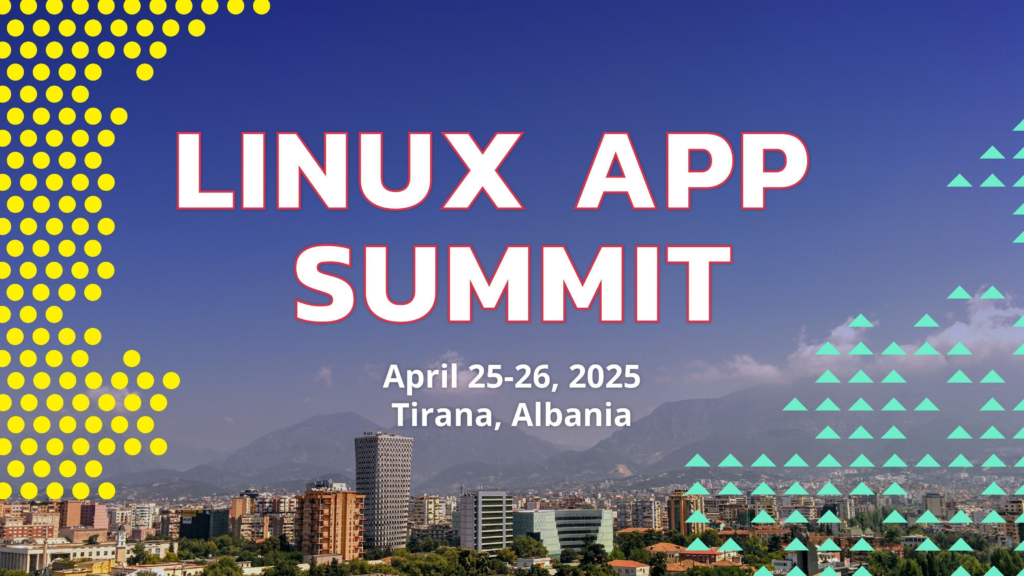
    The Linux App Summit (LAS) 2025 is just around the corner, and we’re thrilled to remind you that registrations are now open for both online and in-person attendees!

    Event Dates: April 25-26, 2025
    Location: Tirana, Albania

    Join us for two days of inspiring talks and community engagement. Whether you’re are a developer, a contributor, or someone curious about the open source ecosystem, LAS is the perfect place to connect, learn, and share ideas.

    Register now: Linux App Summit Registration

    Stay tuned for more updates, and we can’t wait to see you in Tirana!

  • GNOME Internship: Get Ready for GSoC and Outreachy!

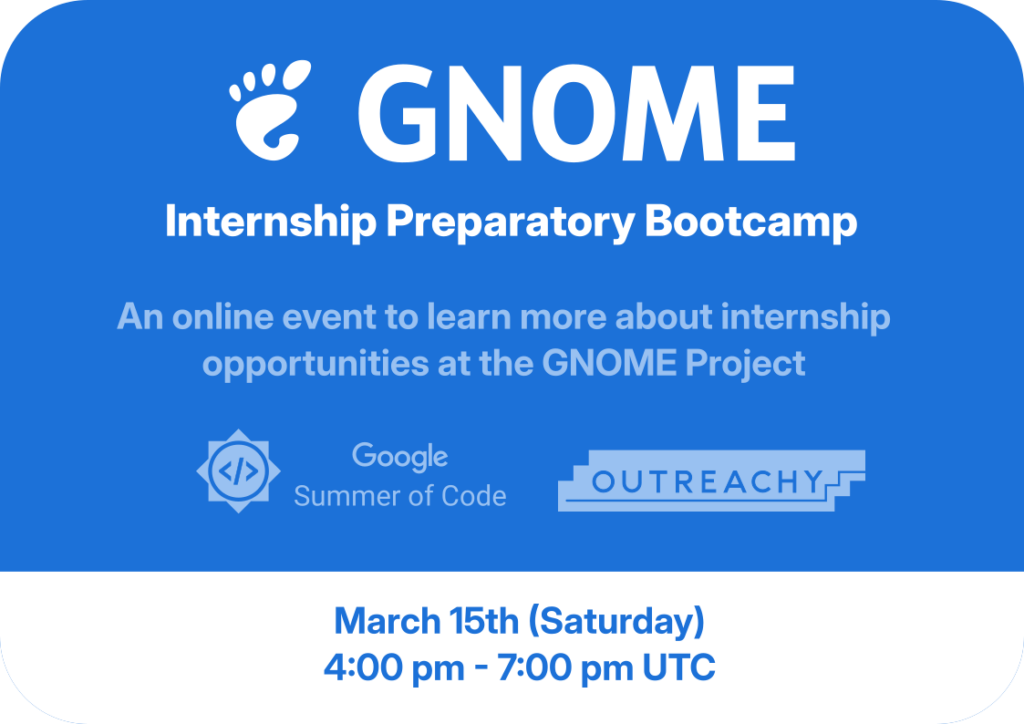
    Exciting news! The GNOME Internship Committee and Open Source Community Africa (OSCA) are teaming up to host the GNOME Internship event!
    If you plan to apply for Google Summer of Code (GSoC) or Outreachy internships, this online event is for you!

    Join us to:
    ✅ Learn about these internship programs
    ✅ Gain insights from past participants
    ✅ Ask questions directly to mentors and organizers

    This is a great opportunity to prepare your application, understand the selection process, and boost your chances of success!

    Date: March 15th (Saturday)
    Time: 4:00 PM – 7:00 PM UTC
    Join here: https://meet.gnome.org/rooms/tl3-fsa-gyb-arq/join

    Don’t miss out—mark your calendars and get ready to start your open source internship journey with GNOME

  • Registration Now Open for GNOME Asia 2024

    Registration for GNOME Asia 2024 is now open! This year’s summit will be held from December 6-8, 2024, in the dynamic city of Bangalore, India, with both in-person and remote participation options.

    GNOME Asia 2024 will feature a fantastic lineup of presentations and workshops centered around the latest innovations in the GNOME ecosystem and its community. Whether you’re attending on-site in Bangalore or joining online from anywhere in the world, there’s something for everyone.

    The full conference schedule, including session and speaker details, will soon be available on the event website.

    Registration is open to everyone—whether you’re an experienced developer, new to the open-source world, or simply curious about what’s happening in GNOME. We look forward to welcoming you, both in person and online, from December 6-8!

    Become a GNOME Asia 2024 Sponsor!

    We’re still looking for sponsors for this year’s summit. If you or your company are interested in sponsoring GNOME Asia 2024, please find more details and our sponsorship brochure on the event website or reach out to asia@gnome.org.

This work is licensed under a Attribution-NonCommercial-ShareAlike 3.0.