New and Familiar

Mat's blog on GNOME

  • The Hobby Lives On

    Maintaining an open source project in your free time is incredibly rewarding. A large project full of interesting challenges, limited only by your time and willingness to learn. Years of work add up to something you’ve grown proud of. Who would’ve thought an old project on its last legs could turn into something beautiful?

    The focus is intense. So many people using the project, always new things to learn and improve. Days fly by when time allows for it. That impossible feature sitting in the backlog for years, finally done. That slow part of the application, much faster now. This flow state is pretty cool, might as well tackle a few more issues while it lasts.

    Then comes the day. The biggest release yet is out the door. More tasks remain on the list, but it’s just too much. That release took so much effort, and the years are adding up. You can’t keep going like this. You wonder, is this the beginning of the end? Will you finally burn out, like so many before you?

    A smaller project catches your eye. Perhaps it would be fun to work on something else again. Maybe it doesn’t have to be as intense? Looks like this project uses a niche programming language. Is it finally time to learn another one? It’s an unfamiliar project, but it’s pretty fun. It tickles the right spots. All the previous knowledge helps.

    You work on the smaller project for a while. It goes well. That larger project you spent years on lingers. So much was accomplished. It’s not done yet, but software is never done. The other day, someone mentioned this interesting feature they really wanted. Maybe it wouldn’t hurt to look into it? It’s been a while since the last feature release. Maybe the next one doesn’t have to be as intense? It’s pretty fun to work on other projects sometimes, too.

    The hobby lives on. It’s what you love doing, after all.

  • One Year of Mahjong Solitaire

    I’ve always liked the concept of small five-minute games to fill some time. Puzzle games that start instantly and keep your mind sharp, without unnecessary ads, distractions and microtransactions. Classics like Minesweeper and Solitaire come to mind, once preinstalled on every Windows PC. It was great fun during moments without an internet connection.

    Unsurprisingly, GNOME provided a collection of similar games since its initial release, preinstalled on several Linux distributions. Although GNOME no longer ships an official game collection, its games live on as separate modules on GNOME GitLab, and I’ve continued playing some of them to this day.

    O maintainer, where art thou?

    Unfortunately, several games have become unmaintained in recent years. While the games more or less work as expected, users still send occasional feature requests and bug reports that remain unanswered, and the UIs drift further away from modern standards (GTK 4 + libadwaita) each year.

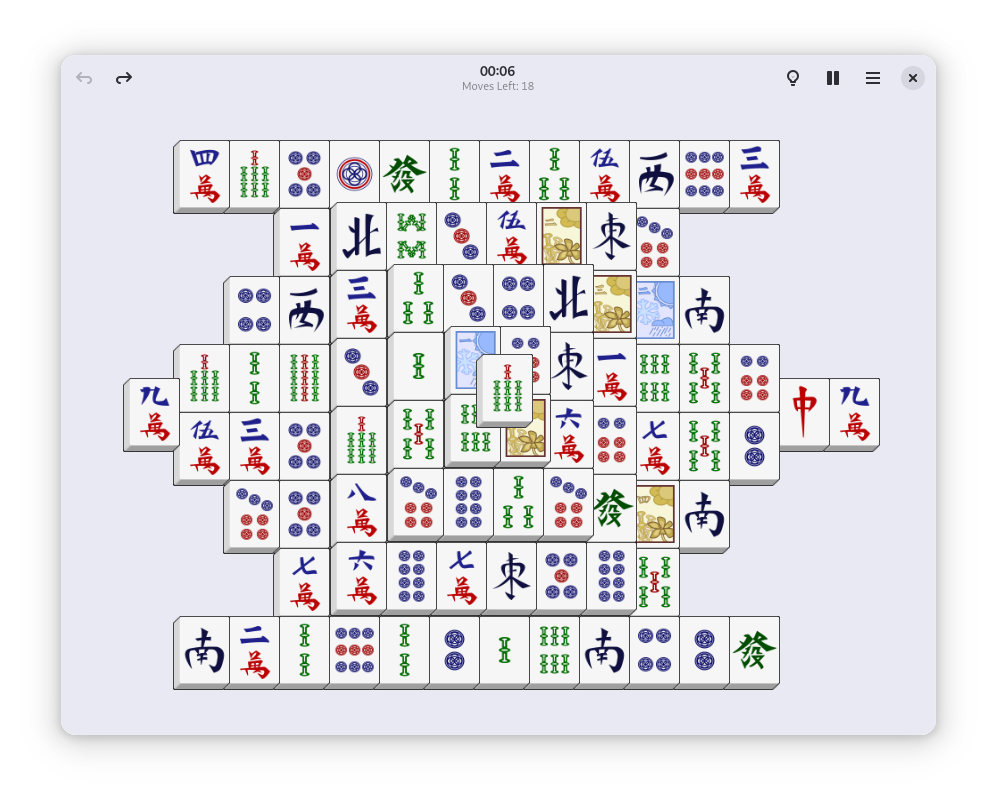
    One game stuck in an unfortunate state was Mahjongg (a Mahjong Solitaire clone), suffering from issues such as high CPU usage and freezes when playing the game. While fixing the issues was easy enough, distributing the fixes proved more difficult, with nobody left to include them in a new release.

    One year later

    After unsuccessfully hunting for poor souls willing to make a new release, my journey as Mahjongg’s new maintainer began a year ago. While my initial plan was to make a single release fixing critical bugs, modernizing the UI and fixing other long-standing issues turned out quite fun in the end. Here are some of the highlights since then:

    • All old issues/feature requests addressed and closed (some dating back over a decade)
    • Several improvements contributed by users (sequential/random layout rotation, remembering game state between sessions)
    • Fixes for various bugs and memory/resource leaks
    • Performance improvements, avoiding several seconds of delay when starting the game and changing layouts
    • Modernized Scores dialog and other UI/UX improvements, following the latest GNOME Human Interface Guidelines
    • Improved tile reshuffling that avoids unsolvable tile arrangements when possible
    • Tile drawing ported from Cairo (CPU-based) to GtkSnapshot (GPU-based), for more efficient drawing and less work porting to GTK 5 in the (far) future

    A game of Mahjongg on the Turtle layout

    Applying for GNOME Circle

    It’s perhaps no secret that the old GNOME games are stuck in an awkward place, with some still using legacy GNOME branding despite no longer shipping with GNOME. In search of a better future for Mahjongg, I applied for its inclusion in GNOME Circle, a collection of high-quality apps and libraries that extend the GNOME ecosystem. After good initial impressions, thanks to recent modernization efforts, Mahjongg is on track for inclusion.

    Since GNOME Circle currently lacks other games, I would love to see more small games added in the future, whether it be one of the old GNOME games or a completely new one. While it’s up to each maintainer whether or not they want to go through the effort, high-quality games deserve more exposure. :)

    Closing words

    Thanks to both the Release Team and the Infrastructure Team for helping me get started, as well as everyone who has contributed to Mahjongg so far. Thanks to everyone who helped write the GNOME Project Handbook, making the lives of contributors easier.

    A few GNOME games are still unmaintained and use GTK 3:

    If you enjoy a challenge, and are interested in porting a game to GTK 4 + libadwaita and maintaining it, perhaps this is the opportunity for you!

    Download Mahjongg

    Get it on Flathub