✔ GNOME Gitlab achievement unlocked
✘ Write something about ‘life-work balance’ here

✔ GNOME Gitlab achievement unlocked
✘ Write something about ‘life-work balance’ here
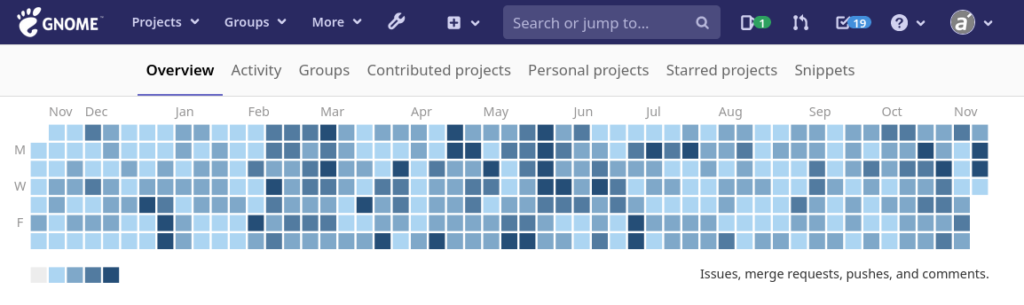
Looks like since the release of GNOME 3.34.0 in September 2019 I made exactly 500 commits in GNOME Git. :)

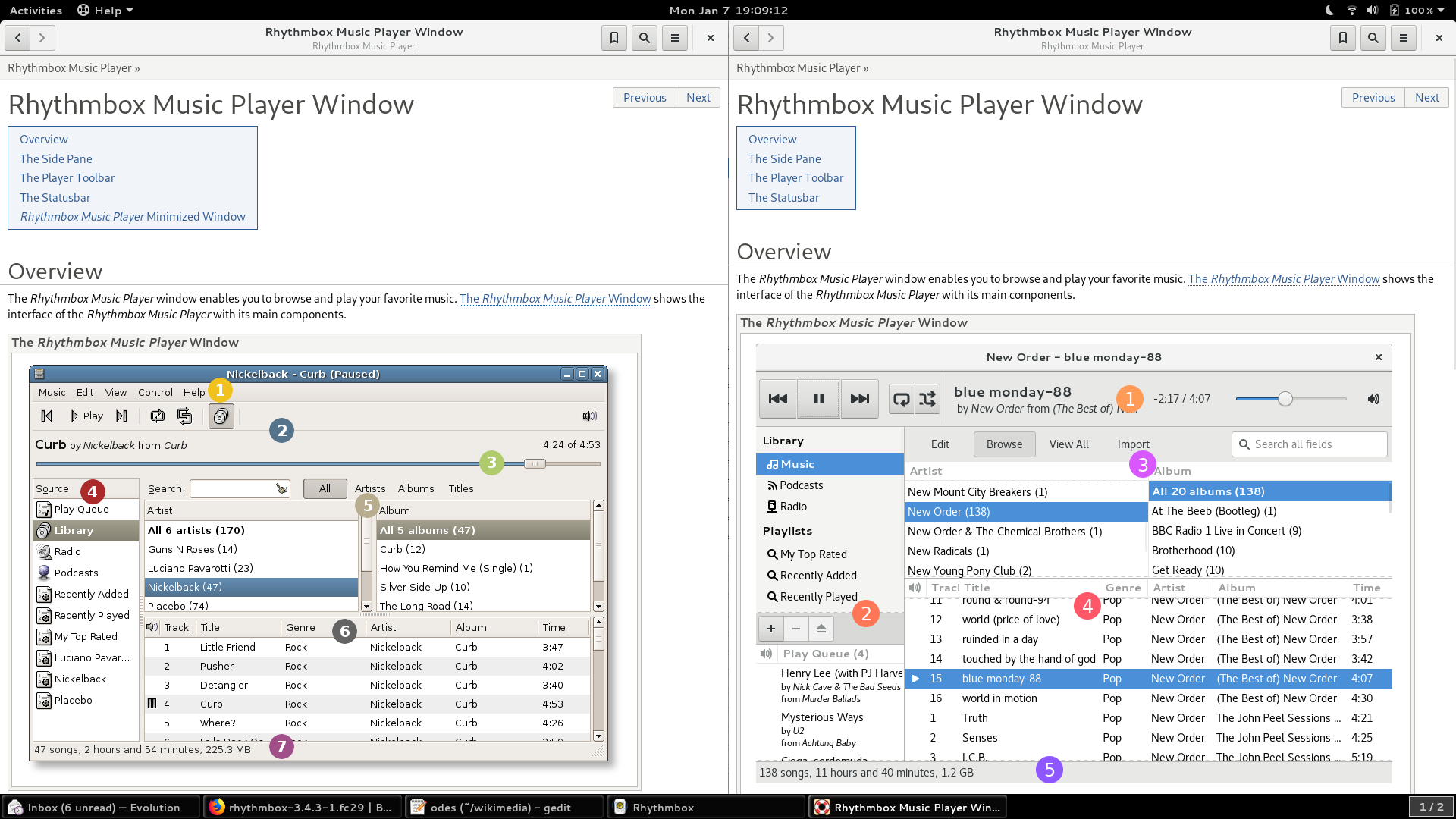
Localized screenshots shipped in GNOME 3.34 versus the same screenshot in 3.36
My main focus was on updating documentation. The user help of cheese, gnome-klotski, gnome-mahjongg, gnome-nibbles, gnome-robots, gnome-terminal, gnome-tetravex, iagno, lightsoff, quadrapassel, rhythmbox, zenity should be up-to-date in 3.36 again.
(If not, then report issues in GNOME GitLab with the label “8. User Docs” or contribute patches yourself.)
This also included updating a majority of outdated screenshots (both English and localized versions when feasible) across projects.
I also took the liberty to push quite some trivial markup fixes in some translations when a language was not already reserved for translation on GNOME’s translation platform (as such actions would interfere).
A few months ago I wrote an essay on software development planning in FOSS projects. It tries to answer the following questions:
Some parts of the essay are specific to Wikimedia but I hope it can also be useful for other communities. It is published under CC BY-SA 3.0 so feel free to remix.
If you have a similar document for your project, please feel free to share a link in the comments.
Apart from replacing many broken links to git.gnome.org or replacing links to GNOME Bugzilla with links to GNOME Gitlab in many code repositories and wiki pages, in the last months I spent some good time updating random GNOME user docs all over the place:
Enjoy and check the GNOME Wiki if you are interested in working on user documentation!

As part of GNOME’s ongoing migration from Bugzilla to Gitlab, from today on there are no products left in GNOME Bugzilla which allow the creation of new tickets.
The ID of the last GNOME Bugzilla ticket is 797430 (note that there are gaps between 173191–200000 and 274555–299999 as the 2xxxxx ID range was used for tickets imported from Ximian Bugzilla).
Since the year 2000, the Bugzilla software had served as GNOME’s issue tracking system. As forges emerged which offer tight and convenient integration of issue tracking, code review of proposed patches, automated continuous integration testing, code repository browsing and hosting and further functionality, Bugzilla’s shortcomings became painful obstacles for modern software development practices.
Nearly all products which used GNOME Bugzilla have moved to GNOME Gitlab to manage issues. A few projects (Bluefish, Doxygen, GnuCash, GStreamer, java-gnome, LDTP, NetworkManager, Tomboy) have moved to other places (such as freedesktop.org Gitlab, self-hosted Bugzilla instances, or Github) to track their issues.
Reaching this milestone required finding, contacting and discussing over the last months with project maintainers of mostly less active projects which had used GNOME Bugzilla for their issue tracking.
For convenience, there are redirects in place (for those websites out there which still directly link to Bugzilla’s ticket creation page) to guide them to the new issue tracking venues.
Note that closing only refers to creating new tickets: There are still 189 products with 21019 open tickets in GNOME Bugzilla. IMO these tickets should either get migrated to Gitlab or mass-closed on a per-product basis, depending on maintainers’ preferences. The long-term goal should be making GNOME Bugzilla completely read-only.
I also fixed the custom “Browse” product pages in GNOME Bugzilla to get displayed (the previous code expected products to be open for new bug entry). Should make it easier again for maintainers to potentially triage and clean up their old open tickets in Bugzilla.
Thanks to Carlos and Andrea and everyone involved for all their help!
PS: Big Thanks to Lenka and everyone who signed the postcard for me at FOSDEM 2019. Missed you too! :)

Newcomer and Mentor stickers designed by GCI 2017 participant Ashley Zhang, CC BY-SA 4.0.
Google Code-in (GCI) is an annual seven week long contest for 14–17-year-old students exploring free and open source software projects. Organizations, such as the Wikimedia community, offer small tasks in the areas of code, documentation, outreach, research, and design. Students who complete tasks receive a digital certificate and a shirt from Google. The top students in every participating organization win a visit of Google’s headquarters. Students can directly experience how large online projects are organized, collaborate with humans across the planet, and the students’ accepted work is made available to millions of worldwide users.
For the sixth time, Wikimedia was one of 27 participating organizations which offered tasks mentored by community members.
In late 2018, 199 students worked on 765 Wikimedia tasks with the help of 39 mentors. To list only some students’ achievements and show the variety of projects, areas, and programming languages in the Wikimedia community:
…and many many more.
Some students have also written about their experience. Google also posted a summary with statistics.
We would like to congratulate our winners Nathan and Shreyas Minocha, our finalists arcaynia, Jan Rosa, takidelfin and Zoran Dori, and all contributors on their many contributions! We hope to see you around! We would also like to thank all our mentors for their commitment to be available also on weekends and holidays, for coming up with task ideas, working together, quickly reviewing contributions, and for providing feedback what we could improve next time.
Thanks to everybody on IRC, Gerrit, Phabricator, mailing lists, Github, Telegram for their friendliness, patience, support and help.
Wikimedia always welcomes contributions to improve free and open knowledge. Find out how you can contribute.
Google Code-in will take place again soon (from October 23 to December 13). GCI is an annual contest for 13-17 year old students to start contributing to free and open projects. It is not only about coding: We also need tasks about design, documentation, outreach/research, and quality assurance. And you can mentor them!
Last year, 300 students worked on 760 Wikimedia tasks, supported by 51 mentors from our community.
Note that “beginner tasks” (e.g. “Set up Vagrant”) and generic tasks are very welcome (like “Choose and fix 2 PHP7 issues from the list in this task” style).
If you have tasks in mind which would take an experienced contributor 2-3 hours, become a mentor and add your name to our list!
Thank you in advance, as we cannot run this without your help.
GUADEC in Almería was a great opportunity to catch up with some technologies in the GNOME world, hang out with lovely folks again, and spend time at the beach.
That annual list of awkward incomplete pop music preferences: Stuff I listened to a lot in the last 12 months. Which did not necessarily get released in 2017. But mostly, I think. And/or enjoyable gigs.
Noga Erez‘ debut album and Zagami Jericho‘s first EP are my favs.
Followed by the latest release by Moby & The Void Pacific Choir, Sevdaliza‘s debut, and Bulp‘s first album.
Looking back at sets, Recondite, Helena Hauff and Setaoc Mass were long nights that left marks.
Looking back at concerts, EMA, Waxahatchee, Lali Puna, Moderat.
Ufomammut and Shobaleader One were banging.
Being able to see Battery live, after all those years.
Someone please send Days’n’Daze on a European tour.
I’d like to thank my bunch.
It’s been a special year, in many ways.