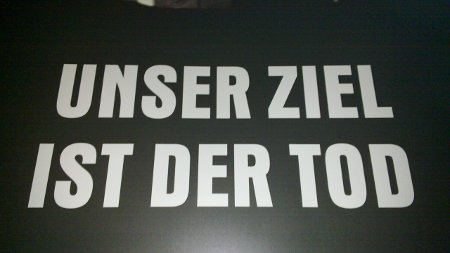
Oder in abgewandelter Form:

Rest in Peace, Christoph Schlingensief.
Ich bin dankbar für all die Einflüße.
Oder in abgewandelter Form:

Rest in Peace, Christoph Schlingensief.
Ich bin dankbar für all die Einflüße.
Nach Lektüre von Texten wie “Mein Jahr in der Linkspartei” und “Der Sozialismus ist gar nicht so übel” in der FAZ (der Artikel ist nicht mehr online verfügbar, aber das Teilfazit) tauchen manchmal Ideale, die Realität da draußen, und die Annäherung beider aneinander auf. Dieser Text verblieb lang, wirr, ohne Folgerungen, selbst nach mehreren Bearbeitungen mit einigen Monaten Zeit dazwischen.

Es geht mir gut.
Aber wenn Tanja als Erzieherin in Deutschland die Hälfte meines Gehalts bekommt leistet sie wahrscheinlich mehr als ich für die Gesellschaft. Meine Werteste fügt bei dieser Überlegung die reine Marktwirtschaft als Verteidigung an – es gibt wenige Menschen, die meinen Job machen können oder wollen. Ich betrachte mich als Wissensarbeiter im Sinne von Peter Drucker.
Mir geht ein “Ich verdiene ganz gut” nicht einfach über die Lippen. Bei Freunden ist das okay, mit einem leichten Lächeln dazu. Bei (in einigen Kulturen als unverschämt betrachteten) Nachfragen nach Genauerem antworte ich mit “Klar, wenn Du Dir sicher bist, daß sich dadurch nicht unser Verhältnis und Deine Sichtweise ändern”. Das fühlt sich manchmal merkwürdig an, wenn Bekannte politisch eher links stehen.
Gerechtigkeit.
Als ich 15 war, war ich grün. Einmal im Monat ging es zum Treffen des “Grünalternativen Jugendbündnisses”. Die Ideale mitsamt ihren Gegnern waren einfach, wohl ähnlich den Zeiten als Teile der westlichen Atmosphäre den Feind einfach systematisch im Osten verorten konnten. Und dann saß ich an einem Mittwoch abend im Auto und hörte, daß Deutschlands rot-grüne (und daher wohl eher linke?) Bundesregierung damit begonnen hatte Jugoslawien zu bombardieren. Da wurde ich dann auf einmal linker als ich wollte, denn es gab nur die PDS im Parlament, die gegen diesen Krieg gestimmt hatte. Da ich nachtragend bin, habe ich viele Jahre gebraucht, um die Grünen wieder als teilweise wählbar zu akzeptieren.
Links zu sein ist immer noch hip in der alternativen deutschen Jugendkultur (und rechts klingt nach Nazi und damit automatisch böse, auch wenn deutscher Hiphop in den letzten Jahren außerhalb besagter Jugendkultur eine gewisse Verschiebung eingeleitet hat). In Tschechien ist es eher hip, rechts zu sein, nach 40 gestohlenen Jahren durch die Kommunisten. Das richtet sich nicht zwangsläufig gegen Ausländer oder Minderheiten. In Deutschland ist man überrascht, wenn ich anmerke, daß die tschechische Partei der Grünen nicht links steht wie in Deutschland. So schön die linke Idee ist (Sozialismus, nicht Anarchie), sie endete in den letzten 150 Jahren immer in authoritären Diktaturen. Sozialismus im Kleinen (wie in einer Wohngemeinschaft) könnte funktionieren, wenn man Regeln, Geld und Eifersucht geklärt hat. Geschichtsverklärung ist populär. Die Deutschen besitzen sogar einen Begriff dafür, Ostalgie. In Tschechien gibt es keinen Begriff für die ewig gestrigen (und damit konservativen) Wähler der Kommunistischen Partei, welche im Gegensatz zur ostdeutschen Linken bisher keinerlei Ansätze von Geschichtsaufarbeitung und Reformismus gezeigt hat. Ihre Wähler haben wohl oftmals profitiert in dieser Zeit. Diese Menschen sterben langsam aus.
Eher linksorientierte Menschen sind fast immer an Gerechtigkeit interessiert. Ich schätze diesen edlen Idealismus sehr, hinterfrage dann gerne den Konflikt zwischen Solidarität in der Gesellschaft und dem zunehmendem westlichen hedonistischen Invidualismus.
Meint “Soziale Gerechtigkeit” nun Verteilungsgerechtigkeit (denen, die mehr verdienen etwas wegnehmen und denen, die weniger verdienen dies dann geben, auch wenn erstere manchmal mehr Leistung bringen, sei dies nun persönlich gewollt oder nicht) oder “nur” Chancengerechtigkeit (denen, die aus einem ärmeren Elternhaus kommen die gleichen Bildungschancen gewähren)? Und was ist genau diese “Umverteilung”, nachdem die “soziale Gerechtigkeit” in den letzten zehn Jahren von wohl allen größeren deutschen Parteien beansprucht wurde?
Ich weiß, daß ich das deutsche Grundgesetz mag. Ich mag keine Bestrebungen, die meine Rechte aufgrund eines “abstrakten Gefährdungspotentials” einschränken, und es beunruhigt mich daß getroffene Maßnahmen nicht nach einiger Zeit auf ihre Effektivität überprüft werden. Ich klage, wenn nötig, um diese Freiheit zu verteidigen, denn ich sehe dies als staatsbürgerliche Pflicht an. Ist das nun liberal, oder doch eher republikanisch? Und wenn ich mir nicht sicher bin, dann bin ich konservativ, dann bleibe ich bei dem, was ich habe und sich bewährt hat.
Meine Werteste ist überrascht, daß ich Katholik bin. Religion sei doch etwas für schwache Menschen?
Ich betrachte mich selbst als konservativ und liberal. Freunde und Arbeitskollegen widersprechen. Interessant und sehr hilfreich war der Selbsttest von The Political Compass, welcher neben den Kategorien “Left” und “Right” zusätzlich “Authoritarian” und “Libertarian” aufführt. Seither verstehe ich mich besser mit mir.
Deutschland hat die soziale Marktwirtschaft und einen progressiven Steuersatz. Wer mehr verdient, zahlt auch mehr. Tschechien hat die reine Marktwirtschaft (da sich Vaclav Klaus in den Neunzigern gegen Vaclav Havel durchgesetzt hat) und eine Flattax mit geringem Freibetrag. Jeder zahlt hier also einen gleich hohen Prozentsatz an Steuern. Aber was ist nun gerechter?
In beiden Ländern durchsuchen Menschen die Mülleimer und sammeln Pfandflaschen im Park, aber in Tschechien sind diese Menschen sehr oft über 60 Jahre alt. In beiden Ländern gibt es menschenverachtende Beschäftigungen – ich erinnere mich in Braunschweig an eine Person in der Fußgängerzone, deren einzige Beschäftigung es war, ein Schild hochzuhalten, auf welchem ein Restaurant 50 Meter weiter beworben wurde. daß ich allein deshalb nicht betreten würde. In Tschechien passiere ich am Museum eine sicherlich über 70 Jahre alte Dame, welche Rosen aus einer Plastiktüte verkauft. Sicher nicht weil es ihr Spaß macht, sondern vielleicht eher weil ihre Rente zu gering ist (die Dame ist allerdings bekannter, wurde mir gesagt). Das fühlt sich ungerecht an, und ich gebe ihr sehr viel lieber etwas Geld als einem Junkie am Bahnhof (weil ich annehme, daß sie es gemäß meinen Ansprüchen “sinnvoller” nutzt), aber das ändert langfristig nichts.
Wie geht nun das langfristige Ändern im Kleinen, wie geht das im Großen? Sozialismus, oder Demokratie und Marktwirtschaft? Mischformen? Welches Steuersystem?
Sinnloses Raten, aber was wäre aus dem “Dritten Weg” geworden, den Dubček im Prager Frühling einschlagen wollte? Und wenn in meinen Softwareprojekten Meritokratie ziemlich gut funktioniert (trotz des menschlichen egoistischen Machtwillens und des im klassischen Smith‘schen Sinne für die Gesellschaft positiven Wohlstandwillens durch Spezialisierung), warum könnte das nicht auch eine mögliche Lösung für eine zukünftige Staatsform darstellen? Oder skaliert das nicht mehr ab einigen tausend Menschen und bleibt in der Subsidiarität stecken, wie auch der Sozialismus in der WG?
Gibt es eigentlich existierende Staaten, die eine Meritokratie als Gesellschaftsform haben?
Fragen.
Apart from the usual Release Team service announcement and its charming follow-up street fights and the two short Bugsquad and Localization reports at the
My theory in short: We lose people that attach patches in Bugzilla to dead modules and never get a response. We waste time translating/localizing modules that will never see a release again. We are stalled as we have always been around 50 “supported” languages for the last GNOME releases. And we need ways out of all this.
For those who could not attend my talk and for further investigation, its slides (pdf/odp), data (cvs/odt) and code (sh) are available. The hardest part really is to find the meaningful data in all that noise. While I plan to continue thinking about this any input is welcome.
For the translations part of my talk, as a first step the Releases Comparison table could get a neater URL and another column that calculates the difference in coverage between the last two years, plus linking the entries in the Languages column against the corresponding teams (yes, teams). Teams that lost more than 10% coverage in the last 2 years are: mk, dz, sq, si, ne, en_CA, cy, hr, fa, vi.
Another data source are those languages with no Git activity (0-2 commits in the last 2 years: an, bal, bem, dv, ff, fur, gn, ha, km, ks, ky, nap, tg, yo, zh_trad, zu; 3-20 commits: en_AU, ha, kk, la, ug).
Contacting these drowning translation teams / maintainers in order to ask for problems or if they still have enough time could for example be handled by the Coordination Team.
In case of no response a translation team can be considered dead.
Now one could take a look whether some contributions exist in damned-lies by people that could be interested to become the new coordinator. And/or downstream teams could be contacted and asked whether they are interested in contributing in upstream GNOME, e.g. teams in Fedora, openSUSE, Ubuntu or other distributions.
While becoming the new translation team coordinator is usually handled quite quickly on gnome-i18n mailing list once it is clear that the old coordinator is not around anymore, changing the assignee data in GNOME Bugzilla and getting Git commit access usually take a bit longer and could currently be demotivating bottlenecks. Time to review the rules or to have a survey about this?
For the modules part of it, two warnings could be added to Bugzilla, damned-lies and when checking out via Git for those modules that have not had much activity lately in GNOME Git.
Maintainers of modules that have not seen any commits for a long time (two years?) could be contacted to get a statement about the module’s status (this was done in the past already with mixed results). In case of no answer or a negative answer this could mean “Note: This module is obsolete or abandonned. No work is planned to take place and you might waste your time by filing a bug report or attaching a patch here”.
If we don’t know (yet) this could mean “Note: This module has not seen much activity in the code repository lately” (plus a hint what to do). Of course this first needs a definition for time period and commits thresholds in order to define “not much activity lately”. This could warn patch contributors in Bugzilla to either be patient for a patch review or to contact the maintainer first and it could help translation teams to set priorities and not to translate inactive modules. Another email contact should be provided (probably not the release team but a new team in GNOME?) for the potential case that the maintainer does not respond. However technically I don’t know where the Git activity results could be cached in order to not continiously be queried by several other parts of GNOME’s infrastructure.
As written before, comments, ideas and criticism are welcome. This is still an early stage.
And to talk in general about GUADEC: As usual it felt like holidays but I finally managed to not spend the entire day at the conference venue in order to also see a bit of the city (like the ICJ, the Scheveningen beach and the city center on Saturday). It was great to have my girl with me and to meet with old and new colleagues of the Openismus crew. And I had interesting chats with Amir H. Moin about datamining and the Evolution crew about non-coderelated stuff, both while lying on a beach couch.
It’s 3 AM, GUADEC is big fun as usual, I’m in the hotel lobby, and as I have only seen one summary blogpost on planet.gnome.org yet I’d like to mention that GNOME 3.0 will be released in March 2011.
Good night.
Having attended last year’s GCDS keynote one sentence in the latest GNOME Foundation board meeting minutes scared me: “GNOME.Asia/COSCUP: Richard Stallman will be doing a keynote”.
As I was told that he has received a copy of GNOME’s new Speaker guidelines I still have some (naive?) hope left that people have learned something in the meantime. Time will tell.
Announcing another maemo.org Bugday:
No specific topic set – take a look at our wiki for some ideas.
Bugdays are about hanging out together on IRC, triaging/discussing some reports in maemo.org Bugzilla, and introducing new people into triaging. No technical knowledge needed, no obligations. Step by and say hello to the Bugsquad or become part of it.
Quick update of the list of modules (not necessarily complete) that do not yet work with GTK3.
| GSeal | Deprec. symbols | GTK+ modules | |
| bug-buddy | to do | ||
| epiphany | to do | ||
| gdl | to do | to do | |
| gdm | to do | ||
| glade3 | to do | ||
| gnome-panel | to do | to do | |
| gnome-screensaver | to do | ||
| gnome-terminal | to do | ||
| gnome-utils | to do | ||
| gtk-engines | to do | to do | |
| gtk-vnc | to do (fixed in git but needs new tarball) | ||
| libnotify | to do (fixed in git but needs new tarball) | ||
| libslab | to do | ||
| libwnck | to do | ||
| metacity | to do | to do | |
| raptor | to do | ||
| swfdec | to do | ||
| vinagre | to do | ||
| vte | to do | ||
For a longer list of issues remaining for GNOME 3, take a look at Bugzilla.
Also Migrating to GSettings is required and not covered by this table.
(I’m not the first person to cover this topic, anyway.)
After upgrading my Nokia N900 to the latest software version (PR1.2) I got a “MyNokia” screen after rebooting.
Nokia was kind enough to offer me both subscribing to their MyNokia service by sending Nokia an SMS message and to read the Terms and Conditions of their service (Terms and Conditions that some people consider either incorrect or even illegal).
I assume that in the hurry of getting the PR1.2 release out in time Nokia probably simply forgot to add a “Do not subscribe me” option. But who needs that anyway? It’s hard to imagine why people would not want to use it. You just give Nokia some of your private data and in return you get some cool and totally useful tricks and tips for your N900 that… you had known before already? Nah, come on!
Sending SMS to Nokia costs money as per Terms and Conditions (“Use of the Service may involve transmission of data through your service provider’s network. Your network service provider may charge for such data transmission.”) Also it’s not clear if the message will be sent to an international number or not (different costs).
So I removed the battery to switch off the device. But booting brought up the dialog again. So the available options are “Subscribe” and “Do not use your device”. By subscribing I send them data such as… hmm, what exactly? I cannot find a clear list in the Terms and Conditions. Does Nokia care about my privacy?
After successfully subscribing you receive an SMS welcoming message from Nokia which does not tell you from which exact phone number but there are users that extracted a list.
To unsubscribe I had to send an SMS again to Nokia that I pay for again. So I went to the Settings section and tried to unsubscribe. And failed with a generic error: “Nokia: Attempt to unsubscribe has failed. Go to ‘My Nokia” in Settings to try again. Visit www.nokia.com/mynokia for more information.”
The second sentence told me to try again. So I tried again. And paid again. And failed again. And realized that the UI does not give any indication whether you are currently subscribed or not.
The frustrating user interface could be easily fixed by anybody if the code was open source.
It is not.
Dave pointed out that there is a workaround for this registration. And there are dozens of complaints, also from other series than Maemo, which makes me wonder if Nokia Marketing is actually aware of this.
It was easy to get an answer to my previous question “Does Nokia care about my privacy?”: I simply went to Nokia’s website which states “WE CARE ABOUT YOUR PRIVACY” at the top.
Unfortunately they only offer me a postal address in Finland to find out what that exactly means as I have some open questions left – for example which exact data is stored. In accordance to German law I must be told (§ 6 Abs. 2, § 28 Abs. 4, § 34 Abs. 1-3 BDSG, § 34 Abs. 1, § 43 Abs. 3 BDSG).
As written in the Terms and Conditions, “Except as set forth in Privacy Policy, Nokia shall not be responsible for any removal of the information or content you have submitted (“Material”) from the Service when your registration is terminated.”
IANAL, but that does not sound legal to me.
So if a Nokia Legal person can explain to me how their service and its terms are in accordance to German law (esp. §4 Abs. 3 BDSG) feel encouraged to leave a comment on this blog or send me an email. If this will not happen there are ways to force you to, as already listed here.
PS: Those who find irony in this posting are free to keep it.
(copying from devel-announce-list)
The GNOME Release Team plans to ship GTK+ 2.90 from GNOME 2.31.4 on.
This requires module maintainers to port their modules now (if you don’t want an angry release-team mob soon in front of your house).
We strongly encourage maintainers to
The following modules are affected (list not necessarily complete):
| GSeal | Deprec. symbols | GTK+ modules | |
| bug-buddy | to do | ||
| ekiga | to do | ||
| empathy | to do | ||
| epiphany | to do | to do | |
| evolution | to do | ||
| gdl | to do | to do | |
| gdm | to do | to do | |
| glade3 | to do | ||
| gnome-disk-utility | to do | ||
| gnome-netstatus | to do | ||
| gnome-panel | to do | to do | |
| gnome-screensaver | to do | ||
| gnome-terminal | to do | ||
| gnome-utils | to do | ||
| gtk-engines | to do | to do | to do |
| gtk-vnc | to do | ||
| libcanberra | to do | ||
| libnotify | to do (fixed in git but needs new tarball) | ||
| librsvg | to do | ||
| libslab | to do | ||
| libwnck | to do | ||
| metacity | to do | to do | |
| nautilus | to do | ||
| raptor | to do | ||
| seahorse | to do | ||
| seahorse-plugins | to do | ||
| sound-juicer | to do | ||
| swfdec | to do | ||
| system-monitor | to do | ||
| vala | to do | ||
| vinagre | to do | ||
| vino | to do | ||
| vte | to do | ||
| webkit-gtk | to do | to do | |
For a longer list of issues remaining for GNOME 3, take a look at Bugzilla.